The biggest change with Bitcoin is the shift from it being primarily a retail-focused endeavor to something that looks attractive for institutional investors.
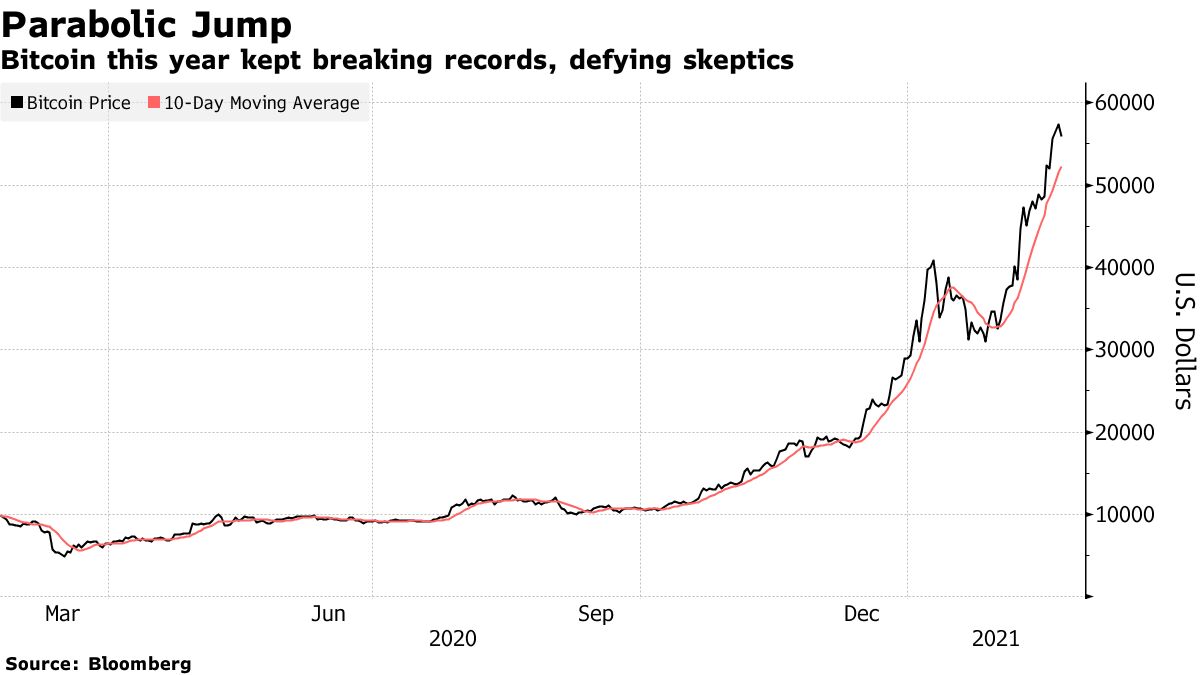
Bitcoin rose as high as $58,350 on Sunday before retreating to about $56,200 as of 2:30 p.m. in Tokyo on Monday. The token has roughly tripled in the past three months but its liquidity has deteriorated, according to Nikolaos Panigirtzoglou, a strategist at JPMorgan Chase & Co.
"Market liquidity is currently much lower for Bitcoin than in gold or the S&P 500, which implies that even small flows can have a large price impact," he wrote in a note on Friday.
Such a backdrop opens up the possibility of sharp moves higher or lower in the cryptocurrency depending on the prevailing ardor for digital assets. Of late, even some of the token's biggest backers appear surprised by its ascent. In a recent tweet, Elon Musk said Bitcoin prices "seem high," having earlier called it a "less dumb" version of cash.
Bitcoin trading volumes are around $10 billion daily for the spot and futures market combined, compared with an equivalent figure of $100 billion for gold, Panigirtzoglou wrote. That's consistent with "much lower liquidity in Bitcoin than in gold," he said.
Cryptocurrencies have enjoyed a strong start to the year, leaving other assets in the dust. The Bitcoin faithful argue corporate treasurers and institutional investors are new sources of demand and that the token can hedge risks such as faster inflation. Others see a prime example of speculative froth stoked by hedge funds and day traders in markets awash with stimulus.
"Bitcoin seems impervious to the barrage of fear, uncertainty and doubt waged against the industry," Paolo Ardoino, chief technology officer at cryptocurrency exchange Bitfinex, wrote in an email.
Shares of Asian cryptocurrency stocks advanced Monday in the wake of Bitcoin's all-time high. One of the biggest movers was Japan's Monex Group Inc., which jumped as much as 16%.
Ether, the largest token after Bitcoin, also rallied over the weekend, topping $2,000 for the first time on Saturday. It's up about 150% year-to-date.
See the piece on Bloomberg here:
In the post-Covid-19 era, it appears that no one will worry much about fiscal prudence. Instead, there is every chance that the fashion for the government to fill individuals' pockets will continue; that the endless promises of green transformation and infrastructure revolution will come good; and, crucially, that governments will prioritise high levels of employment over low levels of inflation. Think of the volume of cash that will spray around economies, and perhaps we are moving into something of a "Keynesian golden age" says Gavekal Research.
All this is wonderful for industrial metals and particularly wonderful for any materials that are at the core of green transformation. There is, for example, no replacement for copper in electrification. The more you think green, the more you need brown metal.
See the article by Merryn Somerset Webb, editor-in-chief of MoneyWeek (Twitter: @MerrynSW ), on the FT here:

For the best part of a decade, commodities have been deeply out of fashion. Now, as investors scour the market for the great reflation play, they’re hot again.
Investing luminaries from Point72 to Pimco are calling for commodity prices to move higher. Goldman Sachs Group Inc., the bellwether of Wall Street, is predicting a new commodity bull market to rival the China-driven boom of the 2000s and the oil price spikes of the 1970s.

"How did you go bankrupt?"Two ways. Gradually, then suddenly.Ernest Hemingway, The Sun Also Rises
"First, when the physical deliveries are miscounted, the paper contract derivative trades overstate short term speculative interest in the metals versus those willing to take ownership. Secondly, and probably more importantly, it overstates the amount of physical metals available for delivery on the futures market for those that want to take delivery. It basically amounts to fraud, much as if your bank claimed to have enough cash for your deposit, and then notified you when you showed up to the bank that you would have to wait 2-3 months to get your cash."!!!

As of August 24, gold bullion1 has gained 27.13% YTD and 39.74% YOY. Gold mining equities (SGDM)2 are up 38.85% YTD and 61.54% YOY. This compares to 7.55% YTD and 11.96% YOY returns for the S&P 500 TR Index.3 Silver has posted outsized gains, climbing 49.03% YTD and 50.00% YOY.
Now that gold has powered over $2,000, it's an excellent time to take stock of what has been accomplished by the monetary metal and what may lie next. As for my Gen-Z "Glow Up" reference (and more below), conversations with my 16-year-old daughter are a constant reminder that I, too, like the gold market, need some updating and modernization.
Most importantly, in our view, it has been established as a baseline that a diversified asset portfolio must include an allocation to gold. We believe this statement is justified by the fact that gold is now the only monetary asset that is priced by a liquid-free market and not directly correlated and partially controlled by central bank (i.e., government) policies and market interventions.
Without once again judging the merits of the exceptional monetary debauchery and fiscal stimuli of 2020, and regardless of an investor's views on credit and equity market valuations or prospects for inflation, there is no other liquid asset which accomplishes what gold does in the way of portfolio insurance and purchasing power protection.
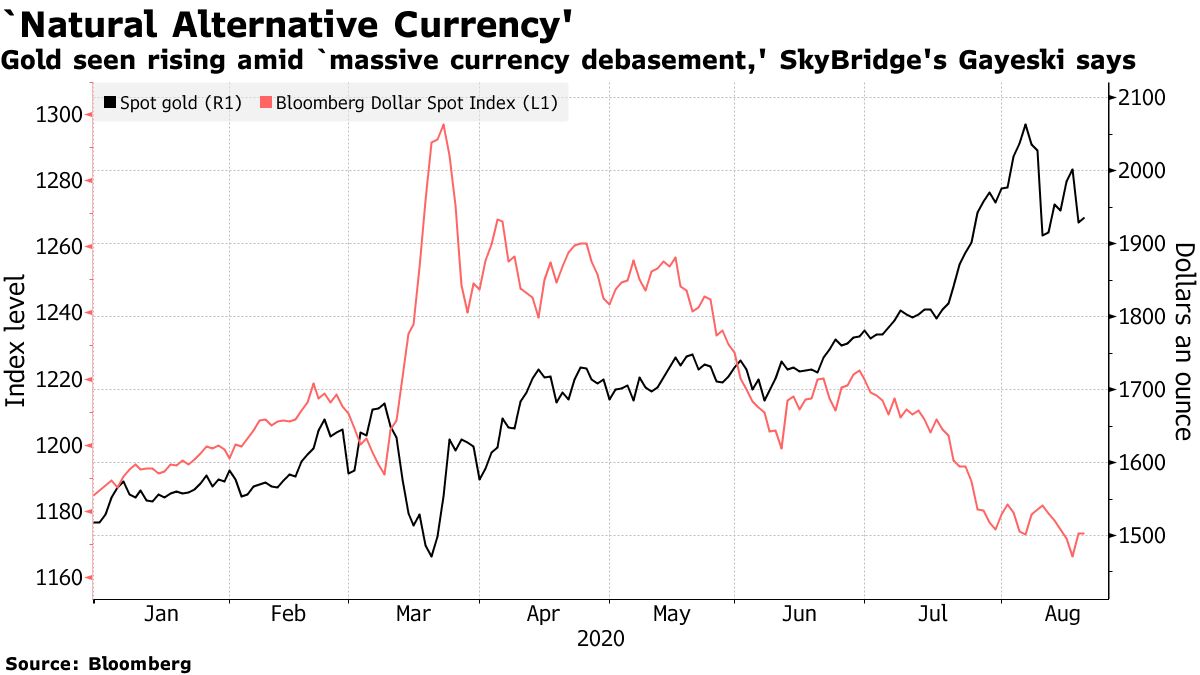
Gold will extend its record-setting rally on "massive currency debasement" and expectations for further stimulus, according to SkyBridge Capital, which recently added exposure to the metal after exiting in 2011.
"When you think of currency debasement the question is, what is the dollar going to weaken against, and when you look around the globe, it's hard to be excited about alternative currencies," said Troy Gayeski, co-chief investment officer and senior portfolio manager, listing the euro, yuan and emerging-market monies. "So, gold is obviously a natural alternative currency."
The precious metal surged to a record well above $2,000 an ounce earlier this month -- although prices have stumbled since then -- as central banks including the Federal Reserve unleashed vast stimulus to support economies hurt by the coronavirus pandemic. That's spurred bets that paper currencies will lose their value as money supply jumps. Goldman Sachs Group Inc. calls gold the currency of last resort and has forecast more gains.
Gold is "fairly rich versus oil or other real commodities, but it hasn't appreciated nearly as much as money-supply growth since its previous peak in September of 2011," Gayeski said in an interview. "It wouldn't surprise us if by the end of next year, it's around the $2,100-to-$2,200 range."
Spot gold hit an all-time high of $2,075.47 an ounce on Aug. 7 as the dollar weakened and real interest rates fell well below zero. On Thursday it climbed 0.4% to $1,936, up almost 28% this year. Prices eased midweek after minutes from the Fed showed it edging away from a step that would underscore a commitment to an extended period of ultra-loose policy.
Ultimately, the driver for gold is "you have massive currency debasement, particularly in the U.S.," Gayeski said.
SkyBridge, which manages $7.35 billion, has about 3% exposure to gold, with the majority of positions taken in the past two months. The fund-of-funds manager's primary exposures are to U.S. cash-flow-generative strategies backed by tangible assets, including residential mortgage-backed securities.
While the latest round of fiscal stimulus talks haven't yet yielded a deal, the Fed has already swelled its balance sheet by about $2.8 trillion this year, with Goldman cautioning that U.S. policy is triggering debasement fears.
The Fed will likely ramp up asset purchases, and there's more fiscal stimulus coming too, according to Gayeski. "All those things argue for a continued bull market in gold, again driven principally by money-supply growth and dollar debasement as opposed to real inflation fears," he said. "Furthermore, expect continued asset inflation long before real inflation ever shows up."
See the article on Bloomberg here: https://www.bloomberg.com/news/articles/2020-08-20/gold-will-gain-on-massive-currency-debasement-skybridge-says?
Related coverage and commentary:

Until recently, the rapid rise in the price of gold had more to do with opportunistic financial trading than any larger structural investment theme, let alone a drop in physical supply or an increase in industrial use.
Now, the metal is seen to offer something for everyone. That is yet another unintended result in a lengthening list of the exceptional involvement of central banks in the functioning of markets. Their expanded interventions to counteract the effects of the pandemic have pleased many now but will create problems for the central banks and the economy at large, if a sharp and lasting economic recovery continues to elude us.
After rising 17 per cent in the first half of the year, gold prices surged to record highs before retreating on Tuesday to just below $2,000. In the process, investors went from treating gold as a short-term momentum trade to seeing it more as a legitimate standalone option in long-term portfolios. You need only look at real yields on government bonds after adjusting for inflation to see why so many investors are buying gold as a long-term option.
Contrary to what most textbooks would suggest, the recent drop in nominal yields has coincided with a rise in inflationary expectations. This makes gold a more attractive substitute for government bonds in two ways. Investors who opt for gold forgo less income than they would if bond yields were higher. They also hedge against what would be a dramatic loss in the value of those bonds, should central banks stop trying to keep interest rates low by flooring official rates and buying massive amounts of market securities.
Gold is also proving compelling for other reasons, collecting quite an unlikely cast of backers in addition to the usual bugs who worry about currency debasement and geopolitical shocks. Some believe it will protect investors against further depreciation of the US dollar; others want it as a hedge against a global economic depression and a collapse in stock markets that, already, are stunningly decoupled from corporate and economic realities. Today's gold camp even manages to attract those looking to protect against competing outcomes: deflation and inflation.
Gold is not the only asset to have developed this multiple and seemingly bipolar personality. Big Tech stocks have also been seen as offering everything to everybody. They promise growth based on the shift from physical to virtual activities in the pandemic, but also downside protection because they have massive cash holdings, low debt and positive cash-flow generation. The collapse in nominal yields on government and safe corporate bonds is also leading some investors to ask whether non-investment grade "junk" bonds can be a safe place to park their money.
Underpinning these contradictory developments is investor faith that central banks will protect them from big losses by continuing to intervene whenever markets slide. Gold is evolving into a "must-have" asset. That drives the price upwards as the pool of potential buyers shifts from a small group of quirky bugs to the much larger pool of investors seeking risk mitigation. Like many sudden structural shifts, it is likely to involve an initial price overshoot.
Think of this as part of a broader shifting baseline. Investors are treating an ever growing number of traditionally risky assets as low risk, or even hedges against risk. In the short term, this pushes prices higher, reinforcing the attitude change and lulling politicians and central bankers into believing that the market cycle has been conquered. But they are likely to prove as wrong as those who, before the 2008 financial crisis, erroneously believed they had vanquished the business cycle.

|
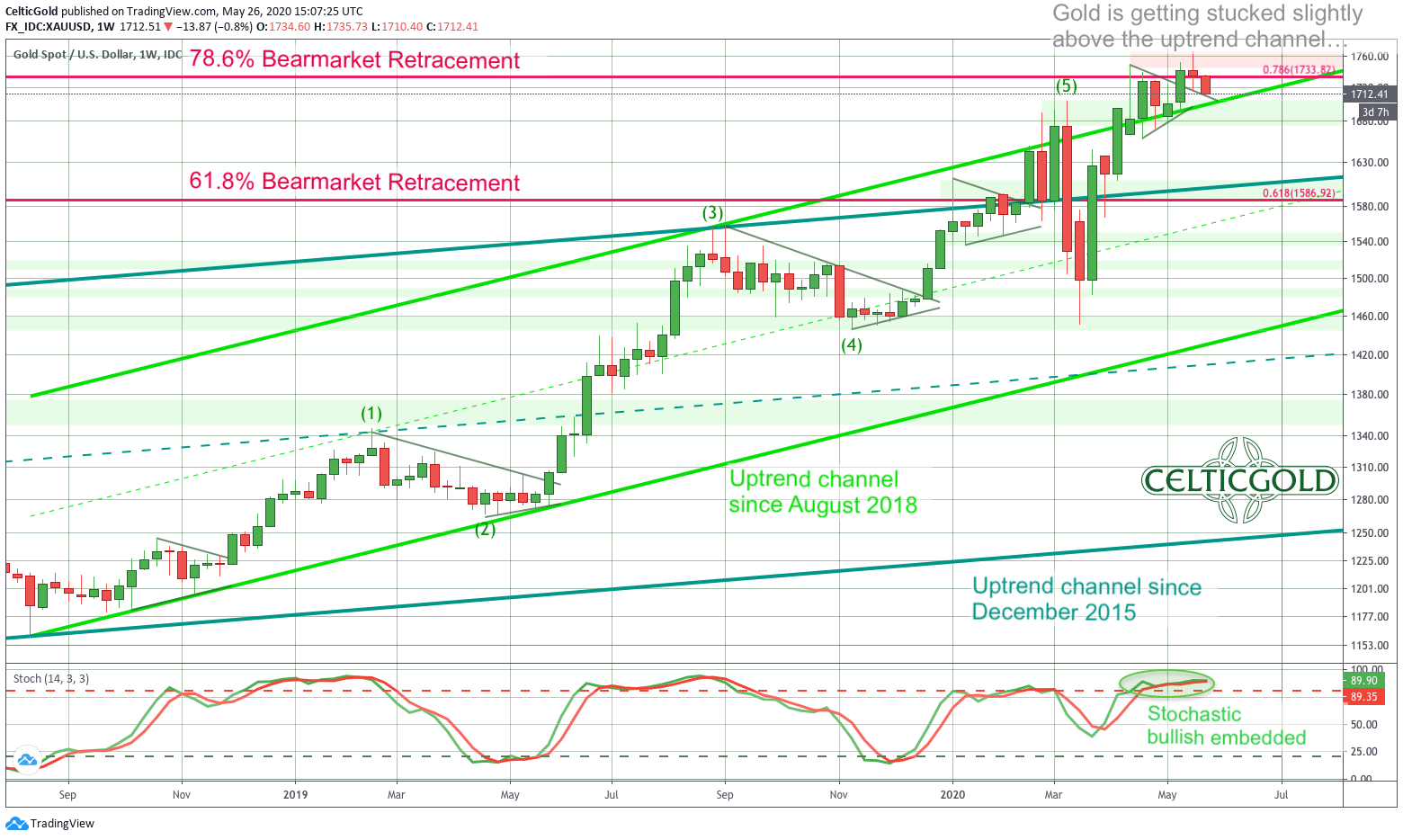
Gold in US-Dollar, weekly chart as of May 26th, 2020. Source: Tradingview
On the weekly chart, gold bulls continue to strive to finally leave the uptrend channel that began in August 2018 behind them. So far, they have not yet succeeded in doing so. Should the bulls now run out of steam or do need a breather, a quick pullback towards the mid of the trend channel would be very likely. However, despite weeks of consolidation at a high levels, there is still no sign of exhaustion. But one could speak of a "dwindling bullish momentum".
It is noticeable that since the beginning of the year gold has been moving primarily in the zone between the 61.8% fibonacci retracements (US$1,586) and the 78.6% fibonacci retracements (US$1,733). These fibonacci retracements relate to the major correction in the gold market when prices fell from US$1,920 down to US$1,045 between 2011 and 2015. Since the final low in December 2015, the bulls have now recovered 61.8% and 78.6% of the lost distance.
Hence, the zone between US$1,586 and US$1,733 is the last place of refuge for the gold bears. If this last bastion can be sustainably conquered, the way to the all-time high at US$1,920 and prices above US$2,000 would be clear. From this perspective alone, the confusing back and forth over the last few weeks is therefore not surprising. At the same time the bears obviously do not (yet) have enough strength to wrest larger space from the bulls here.
However, the stochastic oscillator does not look good on the weekly chart. Both lines are still bullishly embedded above 80, but as soon as the momentum starts to turn, the strongly overbought position immediately will kick in and deliver a sell-signal. In that case a multi-weeks to multi-months corrective phase becomes extremely likely. This is in line with our title Gold – Patience is A Virtue.
All in all, gold prices have been treading water for weeks now and seem to be slightly stuck above US$1,700. However, a trend reversal has not happened. Ideally, the slightly disjointed picture will dissolve with a healthy but overall manageable pullback in the summer months. Alternatively this pullback is already happening….
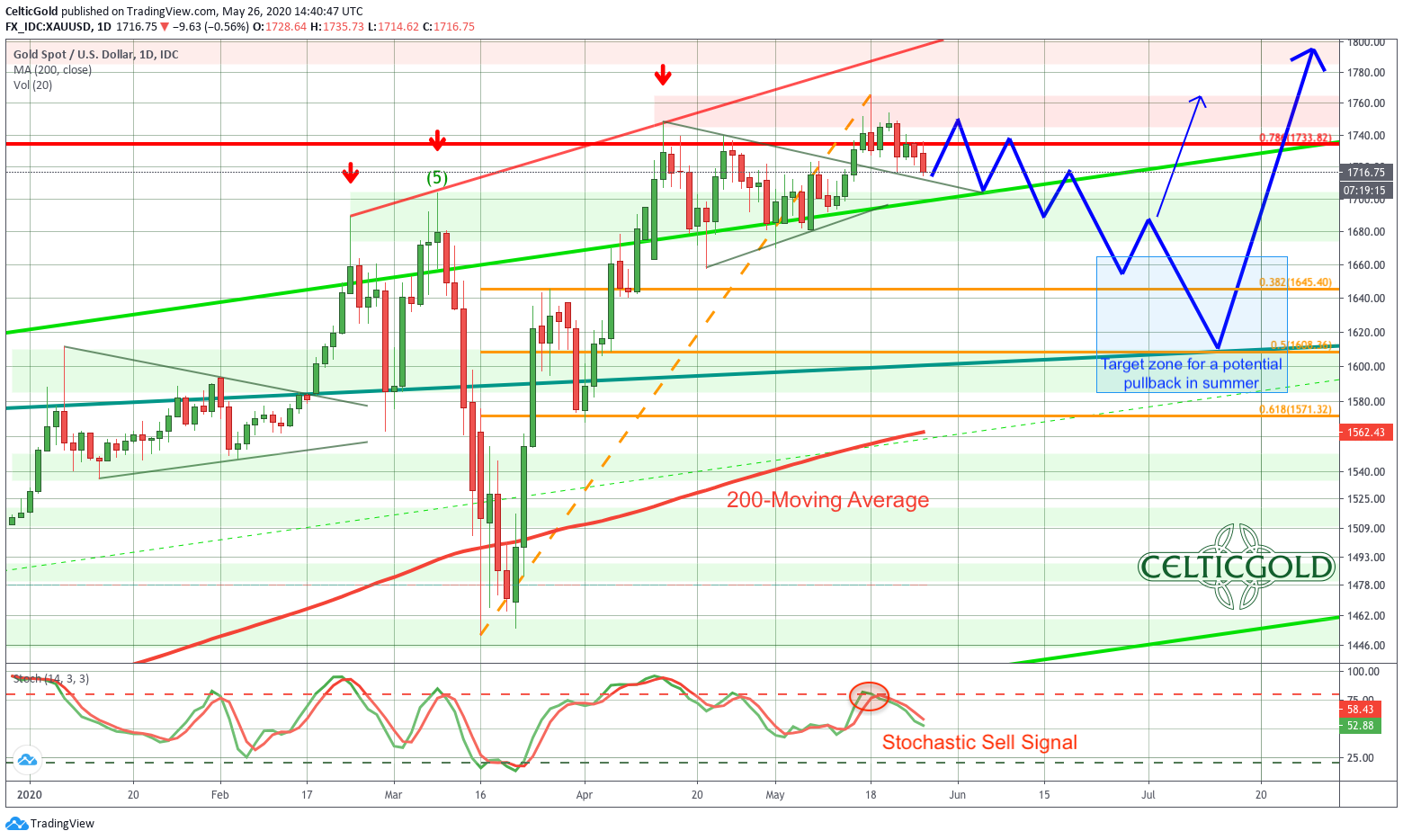
Gold in US-Dollar, daily chart as of May 26th, 2020. Source: Tradingview
On the daily chart, the bulls managed to break out of the five-week consolidation triangle on May 14. With the following spike towards US$1,765 they immediately made it clear who is in charge. In the meantime, however, this actually bullish breakout has already come to an end without any sustained gains, as prices have been falling rather rapidly from US$1,765 down to US$1,698.
Now bulls will have to answer with a bounce and a compelling recovery. However, prices above US$1,730/1,735 might already cause difficulties. Nevertheless, the chances of another wave up into the range between US$1,745 and US$1,765 are pretty good. Especially as the stochastic oscillator he has cooled down considerably on the daily chart and move in the neutral zone. This setup would once again provide enough room for another bullish run.
Furthermore, the silver price, which had just begun to move two weeks ago, does not appear to have reached the end of its rally yet. Rather, silver could pull the price of gold up again for the next few weeks.
In summary, the daily chart is neutral after weeks of consolidation. Similar to last spring and last autumn, gold prices managed to work off the heavily overbought situation without major losses but only with mild declines. Thus, at least in the short term, there is once again the chance of a rise towards the highs of US$1,765 on the chart. Even a new high at US$1,800 can not be ruled out.


Since mid-March, the response of governments worldwide to the covid-19 pandemic has led to disrupted mining activities across the globe.
A total of 32 countries have passed partial or complete lockdown orders, leading to the temporary suspension of activities at over 1,600 mines as of April 3, though that number has since dropped down to 729 as restrictions begin to ease in certain areas, analysts at GlobalData report.
The exempted mines are, however, still operating with reduced numbers of workers to minimize the potential spread of the virus, which is causing a slow return for an industry that has already seen production hit by restrictions.
Among the mining activities affected by covid-19, silver production has been the biggest victim, with nearly 66% of the world's annual output still on hold.