We Will Provide Missing Link for Institutional Investors, Says Fidelity Crypto Head | NewsBTC
Fidelity plans to setup a trading/clearing/custody system that, "permits users to execute trades at one or more exchanges at best price, then determine how to settle. This is what institutional demand requires," Tom Jessop, Fidelity's new Crypto Head, says.
Jessop believes that Fidelity's vaulted cold storagecustody solution, when paired with its traditional security protocols (the "Fidelity standard"), will be the missing link that finally lures a herd of institutional investors into the cryptosphere.
The president of Fidelity Digital Asset Services has spoken about the company's plans in an interview, such as the decision not to launch an in-house exchange, how it intends to attract more institutional investors, and why it's crypto offering is focused on custody and trade execution.
Crypto Paired with More Traditional Financial Models
In his interview with Laura Shin, yesterday, on her Unconfirmed podcast, Tom Jessop, president of Fidelity's new investment arm, outlined the asset management's game plan.
Rather than operating an exchange — which Jessop says "other folks are already doing quite a good job at" — the firm instead wants to focus its energy on creating high quality market access services for its customers.
By digitising the large amount of contracts, letters of credit, invoices and other paperwork currently sent around the world by email, fax or post, and putting them on the Ethereum blockchain platform, they are hoping that the new platforms will lead to faster, cheaper and more secure ways of completing a trade as well as settling the transaction
Energy traders and banks back new blockchain platforms
Aim is to provide faster, cheaper and more secure ways of completing trades
A group of the world's leading energy traders and banks is looking to shake up the centuries-old trade finance industry with the launch of two new platforms underpinned by blockchain technology.
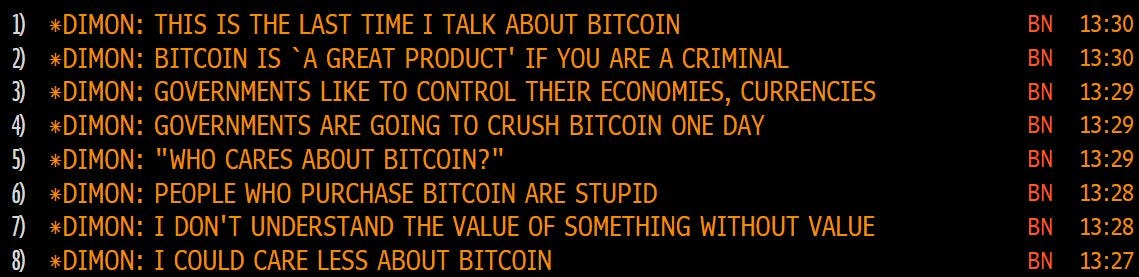
It's easy to believe cryptocurrencies have no inherent value. Or that governments will crush them.
It's also becoming fashionable to believe the opposite: that they will disrupt banks, governments, and Silicon Valley giants once and for all.
Neither extreme is true.
The reality is nuanced and important. Which is why I've decided to write you this briefing note. I hope it helps you appreciate cryptocurrencies more deeply.
Let me start by stating that I believe:
The market for cryptocurrencies is overheated and irrationally exuberant
There are a lot of poseurs creating them, and some scammers, too
There are a lot of conflicts of interest, self-serving hype, and obfuscation
Very few people in the media understand what's going on
Very few people in finance understand what's going on
Very few people in technology understand what's going on
Very few people in academia or government understand what's going on
Very few people buying cryptocurrencies understand what's going on
It's very possible I don't understand what's going on
Also:
Banks and governments aren't going away
Traditional software isn't going away
In short: there's a lot of noise. But there is also signal. To find it, we need to start by defining cryptocurrency.
Without a working definition we are lost. Most people arguing about cryptocurrencies are talking past each other because they don't stop to ask the other side what they think cryptocurrencies are for.
Here's my definition: cryptocurrencies are a new asset class that enable decentralized applications.
If this is true, your point of view on cryptocurrencies has very little to do with what you think about them in comparison to traditional currencies or securities, and everything to do with your opinion of decentralized applications and their value relative to current software models.
Don't have an opinion on decentralized applications? Then you can't possibly have one on cryptocurrencies yet, so read on.
And since this isn't about cryptocurrencies vs. fiat currencies let's stop using the word currency. It's a head fake. It has way too much baggage and I notice that when you talk about Bitcoin in public you keep comparing it to the Dollar, Euro, and Yen. That comparison won't help you understand what's going on. In fact, it's getting in the way. So for the rest of this note, I will refer to cryptocurrencies as crypto assets.
So, to repeat: crypto assets are a new asset class that enable decentralized applications.
And like every other asset class, they exist as a mechanism to allocate resources to a specific form of organization. Despite the myopic focus on trading crypto assets recently, they don't exist solely to be traded. That is, in principle at least, they don't exist for their own sake.
To understand what I mean, think about other asset classes and what form of organization they serve:
Corporate equities serve companies
Government bonds serve nations, states, municipalities
Mortgages serve property owners
And now:
Crypto assets serve decentralized applications
Decentralized applications are a new form of organization and a new form of software. They're a new model for creating, financing, and operating software services in a way that is decentralized top-to-bottom. That doesn't make them better or worse than existing software models or the corporate entities that create them. As we'll see later, there are major trade-offs. What we can say is simply that they are radically different from software as we know it today and radically different from the forms of organization we are used to.
How different? Imagine the following: you grew up in a rainforest and I brought you a cactus and told you it was a tree. How would you react? You'd probably laugh and say it's not a tree because there's no point in a tree being a stumpy water tank covered in armor — after all, water is abundant here in the rainforest! This, roughly, is the reaction of many people working in Silicon Valley to decentralized applications.
But I digress. I owe you an important explanation:
What is a decentralized application?
A decentralized application is a way to create a service that no single entity operates.
We'll come to the question of whether that's useful in a moment. But first, you need to understand how they work.