Follow us on Twitter

Showing posts with label Hedge Funds. Show all posts

Tuesday, February 20, 2024

Another banner year for Best-Paid #HedgeFunds

 
Top 15 Hedge Fund Managers netted $15 Billion in 2023. 

Izzy Englander, Ken Griffin, David Tepper lead the list. 

Wednesday, January 24, 2024

Top #HedgeFunds rake it in in 2023

Another banner year for the leading Hedge Fund managers!

Top #HedgeFunds rake it in in 2023

  • Hedge Funds produced combined gains worth $218BN after fees, according to fund of hedge funds LCH Investments.
  • Chris Hohn's TCI Fund Management made $12.9BN, followed by Ken Griffis' Citadel with $8.1BN, returning ~25% & ~14%, respectively.
  • Top 20 firms, which oversee less than 20% of industry's assets, generated

Tuesday, February 2, 2021

#Greylock, one of the best-known #EmergingMarkets #Debt #HedgeFunds, Finds Itself at Similar Crossroads As Its Previous Targets, #Bankruptcy

US-NYC-SKYLINESome 25 years after its founding, the firm -- its assets headed to a mere $350 million or so by the end of March -- on Sunday filed for bankruptcy protection in New York

Argentina, Mozambique, Barbados and the Republic of Congo have two things in common: They’ve all restructured their debt, and they’ve all tangled with Greylock Capital Management.

Now Greylock, one of the best-known hedge funds in emerging markets investing, finds itself at a similar crossroads. Some 25 years after its founding, the firm -- its assets headed to a mere $350 million or so by the end of March -- on Sunday filed for bankruptcy protection in New York. The firm is seeking to end its lease in midtown Manhattan after investors pulled their money following three years of losses, most recently stemming from the pandemic.

It’s a humbling turnaround for the hedge fund, which made a name for itself for its deep expertise and as one of the more outspoken firms in the emerging-market space, punching well above its weight. While the firm has no plans to shut down, it’s operating at a fraction of its former self: a staff of nine, down from 21 in 2017, and assets at about 30% of their $1.1 billion peak. Paying $100,000 in monthly rent for now-unused Manhattan offices was becoming untenable.
...
Altogether, Greylock’s partners have participated in over 50 creditor committees in more than 30 countries, dating back to the 1980s and early 1990s, including restructuring the debt of several countries into Brady Bonds.

Its more notable deals include Greece, where Greylock was the only U.S. creditor on the steering committee to negotiate the nation’s debt restructuring. The hedge fund also co-chaired a steering committee before Argentina’s notorious 2005 debt restructuring, and was among bondholders that rejected that 30-cent offer. The firm’s partners have been involved with no less than five workouts in Argentina.


Poor Performance

The firm was digging itself out of 3% losses in 2019 from private credit trades gone awry and tighter oil sanctions that pummeled Venezuelan debt when the Covid-19 pandemic hit. The flagship fund plunged about 14% last year as the virus slammed risk assets. Losses were led by Argentina and Venezuela, while the firm continued to write off some private credit trades, according to Mediratta.

Investor withdrawals were mostly spurred by the poor performance. The firm was stung by one particularly large withdrawal by an institution concerned with socially responsible investing that didn’t like the optics of being invested in countries such as Mozambique.

In the absence of new money, assets will drop to about $350 million at the end of March. Despite the recent losses, Greylock’s flagship fund has had annualized returns of 11% since its inception, beating the average hedge fund and JPMorgan Chase & Co.’s benchmark emerging-market debt index over the same span.

Thursday, January 28, 2021

Making $$ from "Democratizing Investing” - The more risk #Robinhood’s customers take in their hyperactive trading accounts, the more it profits from the whales it sells their orders to….

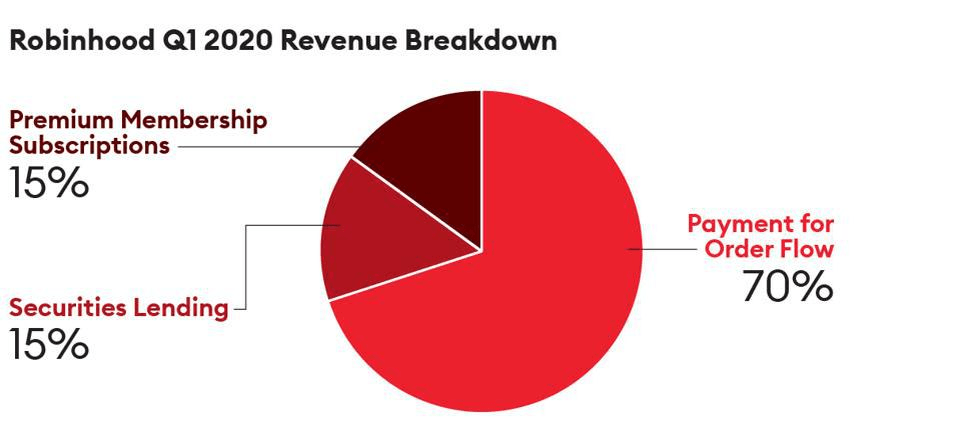
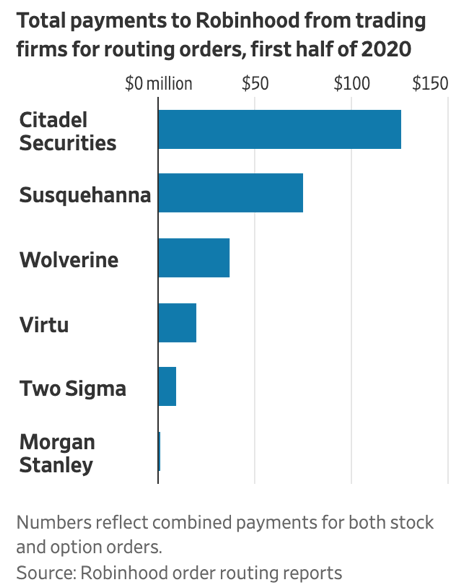
Robinhood earns a majority of its revenue from Payment for Order Flow, with Citadel, Susquehanna and Wolverine accounting for more than 35% of overall revenue


Robinhood: Rise Of The Retail Investor

Robinhood's Revenue streams:

  1. Premium subscriptions: Provides basic features like- Research reports from Morningstar, Level 2 quotes, Increase your instant deposit limit, Extended hours trading (pre-market and after hours), $1,000 of additional margin.

  2. Securities Lending: Let’s its traders use margins in order to trade

  3. Payment for Order Flow: Sells the order flow to bigger operators like Citadel, Point72, and others.

Robinhood has definitely democratized investing but this quote from a Forbes article perfectly encapsulates the other side of the story: “In fact, an analysis reveals that the more risk Robinhood’s customers take in their hyperactive trading accounts, the more the Silicon Valley startup profits from the whales it sells their orders to. And while Robinhood’s successful recruitment of inexperienced young traders may have inadvertently minted a few new millionaires riding the debt-fueled bull market, it is also deluding an entire generation into believing that trading options successfully is as easy as leveling up on a video game.”

It seems like Robinhood has sold the story of helping the average investor but its business model does the exact opposite: sells the little guy to rich market operators with very sharp elbows. This has also landed Robinhood in some regulatory trouble around not being able to fulfill the promise of best execution of the trades while selling the order flow. This has not caused huge troubles till now but can be fairly controversial as the company grows further.

Revenue Diversification

Robinhood earns a majority of its revenue from PFOF which again consolidated in a couple of customers. As shown in the graph Citadel, Susquehanna and Wolverine account for more than 35% of overall revenue. I believe that Robinhood must try to capitalize on its huge user base to diversify its overall revenue profile through premium subscription and securities lending. I believe that this could be achieved if Robinhood starts spending more resources on overall customer education and service. This would kill two birds with one stone as it would decrease regulatory burdens and increase user’s engagement with other paid features hence provide increased stability.

See the whole article here: Robinhood: Rise Of The Retail Investor

Thursday, January 21, 2021

#ValueInvesting guru Seth #Klarman says @FederalReserve has broken the stock market; compares investors to ‘frogs in boiling water’


Baupost’s Seth Klarman
 says the Federal Reserve has broken the stock market:
‘When it comes to the value of cash flows, the vast and limitless future, yet to unfold, has gained considerable ground on the more firmly anchored present’
With so much stimulus being deployed, trying to figure out if the economy is in recession is like trying to assess if you had a fever after you just took a large dose of aspirin,” he wrote. “But as with frogs in water that is slowly being heated to a boil, investors are being conditioned not to recognise the danger.”

Thursday, May 28, 2020

.@Incrementum just published the In #Gold We Trust Report, the gold standard in gold research @IGWTReport

Incrementum just published the In Gold We Trust Report, the gold standard in gold research. 

Key Takeaways

Monetary policy normalization has failed

We had formulated the failure of monetary policy normalization as the most likely scenario in our four-year forecast in the In Gold We Trust report 2017. Our gold price target of > USD 1,800 for January 2021 for this scenario is within reach.

The coronavirus is the accelerant of the overdue recession

The debt-driven expansion in the US has been cooling off since the end of 2018. Measured in gold, the US equity market reached its peak more than 18 months ago. The coronavirus and the reactions to it act as a massive accelerant.

Debt-bearing capacity is reaching its limits

The interventions resulting from the pandemic risk are overstretching the debt sustainability of many countries. Government bonds will increasingly be called into question as a safe haven. Gold could take on this role.

Central banks are in a quandary when it comes to combating inflation in the future

Due to overindebtedness, it will not be possible to combat nascent inflation risks with substantial interest rate increases. In the medium-term inflationary environment, silver and mining stocks will also be successful alongside gold.

Dawn of a new monetary world order

In the decade that has just begun, trend-setting monetary and geopolitical upheavals are to be expected. Gold will once again play an important role in the new monetary world order as a stateless reserve currency.

New gold all-time highs are only a matter of time

The question is not whether the gold price will reach new all-time highs, but how high these will be. We are convinced that gold will prove to be a profitable investment over the course of this decade and will provide stability and security in any portfolio.


________________________
Bit.ly/PangeaBlog
Bit.ly/PangeaFeeds


Wednesday, May 15, 2019

Active vs. Passive Investing? #CapitalGroup Takes on #Vanguard - Bloomberg

Capital Group's founder JBL's "somewhat heretical view at the time was you should actually know something about the companies in which you're investing," Rob Lovelace says. "It was always based on research. This was our comparative advantage. This is in our DNA."

https://www.bloomberg.com/news/features/2019-05-14/the-1-9-trillion-fund-giant-with-a-crazy-idea-about-investing

bit.ly/PangeaBlog
bit.ly/PangeaFeeds

Tuesday, January 15, 2019

Hard Choices: The importance of thoughtful deliberation—and its implications for the future of capitalism Seth Klarman

This is a great piece by Seth Klarman of Baupost. Unlucky with the recent PG&E investment, but a smart man notwithstanding.  He makes some great points that many of us likely share, yet we seem to see so little of in today's world. 

He gave this speech last October when inaugurating a "convening"(?) center he endowed at HBS. 

Highlights are my own. 


Hard Choices:

The importance of thoughtful deliberation—and its implications for the future of capitalism

by Seth Klarman (MBA 1982)

Dear alumni and friends,
We celebrated the opening of Klarman Hall on October 1 and used the occasion to spark discussion and spur thinking on important issues of the day. Beth and Seth (MBA 1982) Klarman, in providing the gift for this remarkable new building, had this very idea of convening as their aspiration. Over dinner, Seth spoke passionately to the group about capitalism and the responsibilities of business leaders. His words resonated with many and I am delighted to share them here, for all the School's alumni, with his permission. May we each be inspired to think carefully about the choices we face.
Regards,

Dean Nitin Nohria


Photo by Susan Young


I suspect there's a great deal that most of us can agree on about capitalism. The free enterprise system, of which HBS is an essential part, has lifted billions of people around the world out of poverty. It provides the backdrop for unleashing boundless human potential. It has made the US an economic powerhouse. It has played a major role in capital being allocated to the most productive uses. Free enterprise has led to the creation of a staggering number of jobs that support families and the invention of a wide range of innovative and affordable products that make people's lives easier, safer, and more enjoyable. In many capitalist economies in 2018, and especially in our own, innovation is unending, and its pace may even be accelerating. The creative destruction of capitalism gives it a remarkable advantage over other systems. You sometimes have to be willing and able to tear down in order to build up. The old and proven and venerable must sometimes give way to the new and innovative and transformational.

But we should also note that capitalism is far from perfect. While it's superior to any other system yet devised, it's subject to sometimes intense cyclicality that can result in turmoil and hardship for many. And we interfere with that cyclicality at our peril, as pent up economic forces will eventually be unleashed with far greater ferocity. Still, under capitalism, markets and economic activity can easily overshoot, in both directions. Fads can be mistaken for trends; the flavor du jour can masquerade as a time-tested recipe. An ephemeral stock price can be made to seem a permanent achievement, an unwavering final verdict. The temporary opinion rendered by the market can be easily confused with actual business success. And those mercurial capital flows, as welcome as they are when they're inbound, can wreak havoc when they reverse, or as they attract undisciplined competitors and drive excess supply at the worst possible moments. Moreover, the aforementioned creative destruction may in aggregate leave society considerably better off, even as it creates both winners and losers, and the losers often suffer through no fault of their own. A capitalist economy should be judged not just on the aggregate economic improvement driven by its innovation but also on the design and strength of the social safety net that cushions the ill, or disadvantaged, or those who simply fail to thrive in their particular setting, geography, industry, or trade. After all, creative destruction is still destruction, even if inevitable and in the service of a net gain to society.
These downsides of capitalism are among the reasons that the system is today less popular than it once was. There are other reasons, as well, that could be covered in a different, longer speech. But we should all keep in mind that the benefits of capitalism are not so obviously and directly attributable to the system the way the adverse side effects and increasing societal inequality are. The invisible hand is, by definition, invisible.
Also, tragically, in a capitalist society (but really in any system), individual or corporate greed can run amuck. Simply put, some will choose to cut corners or cross a line. It's inevitable that laws will sometimes be skirted, frauds sometimes perpetrated, society's resources misallocated, and the environment sometimes damaged. Managements are sometimes tolerated or even embraced who should not be—managements preoccupied with self-interest, managements blind to their own ethical lapses, managements with a record of racist or misogynist or homophobic tendencies. Boards of directors afflicted by conflict or indifference will sometimes look the other way at the actions of their management teams. All of this, of course, is unacceptable. And, nonetheless, it will sometimes happen. Proper governance and regulation are essential to limit the harm, as well as the reputational and financial damage. But governance and regulation exist on pendulums that swing to and fro, and may overshoot in one direction and then in the other.
One of society's most vexing problems is the relentlessly short-term orientation that manifests itself in investing, in business decision-making, and in our politics.

There is, and has always been, a gap between what business is and what it can be, the actual versus the ideal. Every one of us can contribute to widening that gap, or to narrowing it by raising the bar. We will have countless opportunities to choose.
That is really what I want to talk about this evening—choices and the act of choosing. And the way I want to discuss it is by asking questions. They may sometimes seem rhetorical, but they're not. They may sometimes seem straightforward, but they're not. Because these choices are usually hard ones, and tests not just of intellect but of character. They are shaped not just by strategy and analysis but by values.
Chainsaw Al Dunlap, a real person with a Hollywood moniker, told us that a dollar earned by killing a job was just as valuable as one earned by producing a valuable product, and Wall Street was seduced, even though it's obvious that you can't cut your way to prosperity. It's also apparent that a dollar of earnings generated through business expansion may be an annuity, and perhaps even a growing one, while a dollar gained from cost savings is a one-time improvement, an incremental cash flow that is not replicable and one that may even come at a greater cost—short and long term, financial and otherwise—than is readily apparent.
All of us can get carried away with a seemingly good idea taken to excess. Everyone knows the famous movie line, when Gordon Gekko told us that "greed is good." Do any of us really think that greed alone is what motivates a capitalist to strive, invest, and dream, or that it always leads to the best possible outcome? If greed is good, is greedier better? If I were greedier, if I paid my people less and demanded more from them, if I raised the fees I charge and cut my costs, would that make me and my company better off? Certainly not.
Business schools have sometimes taught that shareholder-value maximization is the holy grail, the sole proper focus of corporate managements. So I ask, should managements be focused solely on a company's share price, which itself is ephemeral, and do everything within their power to levitate it? What longer-term good would this possibly accomplish? Isn't it clear that Wall Street goes through mood swings, that what might float the market's boat this week might sink it the next? And might not an artificially inflated stock price tempt management into acutely short-term-oriented and potentially, even value-destructive practices in order to maintain it or inflate it further? And does anyone really believe that shareholders are the only constituency that matters: not customers, not employees, not the community or the country or planet earth?
Of course, every businessman and woman has the right to decide that their business exists solely to maximize profits. But let's stop to examine what that even means. What are those things that cause profits to be maximized? And should we be aiming to maximize them this year, or next year, or only over the fullness of time? Is short-term optimizing a waypoint on the road to long-term maximization, or could it be anathema to the achievement of that goal?
So let me ask, does paying employees as little as you can get away with serve to maximize profits, or does treating them fairly and respectfully, and even generously? Maybe it's not just society that should offer a safety net, but also companies, where they recognize that employees are, first and foremost, people who must manage through the volatility we all experience over the course of our lives. Employees are there every day working hard to serve their employer, and I believe it's very much in the employer's interest to also be there for them.
I ask you, does it maximize profit to treat customers well by selling them products that represent good value for the money, or is it best to charge them as much as you can while providing them as little as you must? Doesn't reputation matter as well? What kind of corporate citizen you are, what kind of employer you are, whether you are a steward of and not a destroyer of the environment, and of your communities? Don't people prefer to work for and do business with a generous company? A company with sound values that every day chooses to live up to them, one that thoughtfully positions itself within the greater landscape of business, government, and society at large. Doesn't that motivate employees to be at their best?
Companies face choices, and their managements must choose. It's a choice to do things that "maximize profits," to pay people as little as you can, or work them as hard as you can; it's a choice to maintain pleasant working conditions or, alternatively, particularly harsh ones: to offer good benefits or paltry ones.
It's also a choice to try to win every business negotiation, to squeeze out every dollar of profit, to crush your counterparty. It's a different kind of choice to not do that, to aim for "win-win" outcomes, to leave the other side with profit and dignity and goodwill, to build relationships that last not for a single deal, but for a lifetime of them. It's a choice to always keep your word, even when that is costly or difficult or unpopular.
It's a choice to leverage up your company to the hilt, to pile on nonrecourse debt to pay special dividends to the owners and then walk away if the business falters and the debt comes due. Just because you can do something definitely doesn't mean that you should.
Consider corporate time horizons. It's a choice to attempt to maximize corporate results over the very short run and a different and sometimes harder decision to take a longer-term view. I'm convinced that one of society's most vexing problems is the relentlessly short-term orientation that manifests itself in investing, in business decision-making, and in our politics. Educational and philanthropic endowments, for example, with institutional time horizons that necessarily span centuries, invest their funds with monthly performance comparisons. Jeremy Grantham (MBA 1966), cofounder of the global investment firm GMO, recently observed in the context of governmental inaction on climate change, "We face a form of capitalism that has hardened its focus to short-term profit maximization with little or no apparent interest in social good."
Politicians who represent cities, states, and countries—entities that aspire to go on forever—must nonetheless run for reelection every few years. In some cases, they no sooner win one election than they are forced to run for reelection. Fearing loss of their seats, they become almost paralyzed into inaction. Politicians tend to follow the polls instead of their hearts or brains. They listen more to political consultants than to voters. Our short-term-maximizing politicians fail to tackle longer-term societal challenges such as climate change or unaffordable entitlement programs and the resultant on-and-off balance sheet liabilities. They never even bring these vexing issues up for debate. And of course, the best hope for dealing with such problems is to tackle them early, when there may be time to deal with them somewhat gradually, before things reach crisis proportions.
Many feedback loops reinforce today's short-term business and financial-market orientation. Louis Gerstner Jr. (MBA 1965), former CEO and chair of IBM, has written that you always get more of whatever you measure. Certainly, the constant measurement of professional money managers pressures them to perform well over the shortest measurement horizons. The more pressure you put on money managers for near-term performance, the more short-term their focus becomes. And the more pressure Wall Street puts on corporate America to deliver strong short-term performance, the more myopic the underlying businesses become.
A big part of leadership is deciding, and good decision-making benefits from intelligence, thoughtful deliberation, and experience, but also, as i hope you agree, from sound values.

No one in the investment business wants to be fired for poor performance (what Jeremy Grantham calls "career risk"). No money manager wants to lose their clients. No corporate CEO wants to be terminated. And as a result, few are willing and able to invest for the long run, to make long-term-oriented decisions, to put aside the short-term performance pressures and personal career or compensation considerations to do the right thing for the business. With excessive short-term pressure, even the wisest and most capable fiduciaries can bend and even break.
As human beings, we experience time quite differently from the institutions we create, populate, and lead. Even when we want to do the right thing, there are bosses, clients, and markets overtly or subliminally pressuring us to take the short view. As John Maynard Keynes famously noted, "In the long run we are all dead." It might be tempting to believe that the long run is simply a series of short runs, but the reality is that immediate pressures can overwhelm the long-run view, and even cause us to take actions that are the opposite of what a truly long-term orientation would produce.
We must all be more aware of the distortions and outright mistakes that can arise from too much focus on the near term. But simply extending your focus to the temporal horizon is insufficient. Have you really inoculated your decision-making just by shifting from short-term greedy to long-term greedy? David Brooks was on the right track when he observed: "The things that lead us astray are short term. …The things we call character endure over the long term––courage, honesty, humility."
Corporate managements are employed to navigate, to steer the ship, to set a course, and then to make regular midcourse corrections. They are there to decide. And in business, you must often decide quickly, without complete information or the time to consider every alternative or resolve every uncertainty. Because, of course, to decide slowly is sometimes to decide too late, to miss opportunities rather than seize them. Harvard Business School's case method compresses many hundreds of real-life decision-making constructs into a two-year academic experience. HBS students learn to build decision-making teams, assess problems, gather information, debate, and decide, hopefully wisely. And then take responsibility, learn from mistakes, reset assumptions amidst a rapidly evolving world, and decide some more. A big part of leadership is deciding, and good decision-making benefits from intelligence, thoughtful deliberation, and experience, but also, as I hope you agree, from sound values. Choosing what to maximize, how, and over what time frame, is an expression of those values. The commitment to reconsider, evaluate, question, and modify your decisions in light of your values is an expression of character.
With an overly narrow focus on the near-term maximization of corporate profits and share price, business leaders leave themselves vulnerable to criticism and harsh regulation. When business owners and business schools fail to regularly ask hard questions about capitalism and its impact on people of every skill set and background, we increase the chance that when these questions are asked, they will be asked by ideologues seeking to point fingers, assign blame, and make reckless changes to the system. One US senator recently unveiled the Accountable Capitalism Act, which requires corporations of a certain size to procure a federal charter that would require 40 percent of corporate boards to be composed of employees. This seems both ill-considered and unlikely to work. I doubt this bill will become law. But when capitalism goes unchecked and unexamined, and management is seduced by a narrow and myopic perspective, the pendulum can quickly swing in directions where capitalism's benefits are discounted and its flaws exaggerated, thereby leaving its future even more clouded and uncertain. While it's hard to see how this proposed regulation would solve the problems that I've raised tonight, it's exactly the kind of proposal that business will have to contend with when complex issues go unexamined, and when character, sound values, restraint, and long-term thinking fail to gain the upper hand.
To move society forward, complex and challenging issues must be addressed. This new convening center can and must be part of the solution. Beth and I sincerely hope that people will convene here, respectfully debate the most challenging issues here, and identify potential solutions here. With HBS faculty and students driving the conversations, we are optimistic that HBS and Harvard can be at the forefront of new conversations, fresh ideas, and innovative solutions.
 

#HedgeFunds Held Close to 20% of $PCG stock. That Bet Flopped #PGandE

"Some hedge funds be­gan buy­ing into PG&E in late 2017 af­ter the wine-coun­try fires in­tro­duced un­cer­tainty around the com­pany and drove down its stock price. By the third quar­ter of 2018—the most re­cent quar­ter for which such data is avail­able—PG&E was one of the hedge-fund in­dus­try's most widely held stocks. About 19% of PG&E stock was held by hedge funds at the end of the third quar­ter, up from 3.4% a year ear­lier, ac­cord­ing to Fact­Set."

In­vest­ment funds in­clud­ing Av­enue Cap­i­tal Group, El­liott Man­age­ment Corp. and King Street Cap­i­tal Man­age­ment LP on Mon­day were buy­ing PG&E bonds, ac­cord­ing to peo­ple fa­mil­iar with the firms. Sev­eral traders said they ex­pected a bank­ruptcy set­tle­ment would re­pay bond­hold­ers in full, based partly on ex­pec­ta­tions that PG&E would set­tle its wild­fire li­a­bil­i­ties for less than ex­pected. As a reg­u­lated util­ity, PG&E also still has cash flow to pay cred­i­tors, and an­a­lysts said Mon­day's clos­ing share price of $8.38 re­flects the po­ten­tial for some kind of res­cue by Cal­i­for­nia law­mak­ers or reg­u­la­tors lead­ing up to the ex­pected bank­ruptcy fil­ing."

Read the full story on The Wall Street Journal here: 

PG&E Was a Hedge-Fund Darling. That Bet Flopped.

bit.ly/PangeaBlog

bit.ly/PangeaFeeds


Monday, October 29, 2018

.@Fidelity hopes its Trading-Clearing-Custody-#ColdStorage system for #Crypto Assets Will be the #MissingLink to lure Institutional Investors

We Will Provide Missing Link for Institutional Investors, Says Fidelity Crypto Head | NewsBTC
Fidelity plans to setup a trading/clearing/custody system that, "permits users to execute trades at one or more exchanges at best price, then determine how to settle. This is what institutional demand requires," Tom Jessop, Fidelity's new Crypto Head, says. 
Jessop believes that Fidelity's vaulted cold storage custody solution, when paired with its traditional security protocols (the "Fidelity standard"), will be the missing link that finally lures a herd of institutional investors into the cryptosphere.
https://www.newsbtc.com/2018/10/27/fidelity-will-provide-missing-crypto-link-for-institutional-investors-says-head-of-investment-arm/?platform=hootsuite


We Will Provide Missing Link for Institutional Investors, Says Fidelity Crypto Head

The president of Fidelity Digital Asset Services has spoken about the company's plans in an interview, such as the decision not to launch an in-house exchange, how it intends to attract more institutional investors, and why it's crypto offering is focused on custody and trade execution.

Crypto Paired with More Traditional Financial Models

In his interview with Laura Shin, yesterday, on her Unconfirmed podcast, Tom Jessop, president of Fidelity's new investment arm, outlined the asset management's game plan.
Rather than operating an exchange — which Jessop says "other folks are already doing quite a good job at" — the firm instead wants to focus its energy on creating high quality market access services for its customers.

Friday, June 20, 2014

Chandler is at it again: Singapore Billionaire Bets Big on #Energy in #Africa, #Asia @Businessweek

Here's a piece on the secretive New Zealand investor from BusinessWeek.


Singapore Billionaire Bets Big on Energy in Africa, Asia

In September 2007, almost a year after New Zealand–born billionaire Richard Chandler founded investment firm Orient Global in Singapore, he made a rare appearance at a forum on social responsibility. Abandoning his penchant for privacy, Chandler outlined the link between giving and investing.
“We start to ask the question, where would the incremental dollar achieve the greatest return?” said Chandler. “Charity is good, performance philanthropy is better, and social investment is best.”
Chandler attended the global executive summit in Singapore again the following year -- and then dropped back out of public view, Bloomberg Markets magazine will report in its July/August issue. He doesn’t speak to the press. Current and former employees of his firm, now called Chandler Corp., don’t talk about him, citing nondisclosure agreements. Executives of most companies in which Chandler invests deal only with his staff.
“I never met him and I don’t know him,” says Indian billionaire Malvinder Singh, whose Fortis Healthcare Ltd. sold its entire stake in Vietnamese hospital company Hoan My Medical Corp. to Chandler Corp. for $80 million in August 2013, according to Fortis’s statement.
Behind the silence, Chandler, 55, is amassing a fortune that the Bloomberg Billionaires Index estimated at $3.7 billion on June 18. Energy-related companies account for at least $1.2 billion of his wealth.

Far-flung Locales

Chandler is betting on gas and oil in far-flung locales from Papua New Guinea to Kenya and Ethiopia, banking on demand from Asia’s growing middle class.
The firm invested in InterOil Corp., which has offices in Singapore and Port Moresby, Papua New Guinea. InterOil controls 35.5 percent of the exploration license that contains Papua New Guinea’s Elk and Antelope fields -- the island nation’s biggest undeveloped gas plays, according to InterOil. Chandler Corp.’s 19.6 percent InterOil stake was valued at $639 million on May 30.
Chandler Corp.’s investments in Southeast Asia extend beyond energy to consumer goods and financial services. The firm holds a $366 million stake in Vietnam’s Masan Group Corp. The company makes foods and beverages, offers banking services and mines tungsten and bismuth. In health care, Chandler Corp. owns a minority share of Medical City, a network of three hospitals and 23 outpatient clinics in the Philippines.
Chandler Corp. says its companies deliver health-care services to more than 2.5 million people in Vietnam and the Philippines each year.

‘Social Value’

“We look to invest in businesses that create social value and drive national prosperity,” Chandler Corp.’s website says.
Chandler is building on a fascination with emerging markets that began with Hong Kong in the 1980s and extended to Brazil, Russia and India. He remains famous for his campaign at SK Corp., South Korea’s largest oil refiner, says Seo Jae Hyeong, chief executive officer of Seoul-based Daishin Asset Management Co.
“People still have vivid memories of how an obscure fund waged a war against the SK chairman,” he says.
Chandler and his younger brother, Christopher, bought 14.99 percent of SK from March 26 to April 11, 2003. The shares had plunged 63 percent in five days earlier that March after SK reported it had misstated 2001 earnings at its trading arm by about $1.5 billion.
The Chandlers fought to oust Chairman Chey Tae Won, who’d been convicted of accounting fraud. Investors bought the shares over two years as the battle intensified, and SK boosted outside directors to 70 percent of the board from 50 percent.
By the time Chey defeated the Chandlers’ bid to remove him, in 2005, the stock had soared more than fivefold from the average 9,293 won per share the brothers paid. They walked away with more than $700 million in gains, calculations based on regulatory filings show.

‘Corporate Governance’

“The Chandler brothers contributed greatly to Korea by raising the awareness of corporate governance and provided an impetus for big companies to change,” Seo says.
Christopher Chandler, 54, now owns Dubai-based investment firm Legatum Group. Last year, his Legatum Foundation started the $100 million Freedom Fund with two partners to combat modern-day slavery. Christopher, like his brother, declined to comment for this story.

Sino-Forest

Richard Chandler stumbled in 2012. Chandler Corp. started buying Chinese timber company Sino-Forest Corp. after the company’s shares, which traded on the Toronto Stock Exchange, plunged 84 percent in two days.
Short seller Carson Block’s research firm said in a June 2, 2011, report that Sino-Forest was overstating the value of its assets. Hedge-fund firm Paulson & Co. sold its entire stake after the report and lost C$462 million ($426 million).
Chandler Corp. continued buying until the Ontario Securities Commission halted trading in August 2011. Chandler Corp. amassed a 19.5 percent stake as Sino-Forest’s biggest shareholder.
Sino-Forest filed for bankruptcy protection in March 2012, and the company has since been taken over by bondholders, according to Chandler Corp. David Walker, a forestry expert who’d been hired to lead a turnaround at Sino-Forest, was named Chandler Corp. CEO in January 2013. Chandler Corp. says Walker no longer works there because the firm isn’t involved with Sino-Forest.

Gas Fortune

One of Chandler Corp.’s current emerging-markets bets is liquefied natural gas. Last year, Asia accounted for 75 percent of global LNG demand of 236.9 million tons, according to the Paris-based International Group of LNG Importers.
Africa is growing as a gas supplier. More than 14 trillion cubic meters (500 trillion cubic feet) has been discovered in Angola, Ghana, Mozambique, Nigeria and Tanzania, according to Seah Moon Ming, CEO of Pavilion Energy Pte, the LNG unit of Temasek Holdings Pte, Singapore’s state-owned investment company.
“You can make a fortune in Africa if you can find oil and gas and if it’s economical to get it out of there,” says Jim Rogers, chairman of Singapore-based Rogers Holdings, who correctly predicted a commodities rally in 1999.
Asia’s deep-pocketed investors are expanding globally by acquiring LNG assets. Pavilion Energy said in November it had invested $1.3 billion in Tanzanian gas blocks. In May, Cheung Kong Group, owned by Li Ka-shing, Asia’s richest man, agreed to acquire Envestra Ltd., an Australian natural gas distributor, for A$2.4 billion ($2.2 billion).

‘Seismic Shift’

“LNG is the future,” says Chua Ma Yu, executive chairman of CMY Capital Markets Sdn. in Kuala Lumpur. “Throughout Asia, governments are building LNG terminals and gas pipelines as they respond to this seismic shift.”
Chandler is hunting for further riches in Africa’s petroleum reserves. Chandler Corp. holds a 9.9 percent stake, valued at $220 million, in Africa Oil Corp., a Canadian company that discovered Kenya’s first crude with a partner, Tullow Oil Plc, in 2012.
Africa Oil is a logical choice for bargain hunters such as Chandler, says Stuart Amor, London-based head of oil and gas research at RFC Ambrian Ltd., a natural resources adviser and broker. 
Recent crude discoveries in Kenya may generate about $10 billion in revenue in three decades of production, London-based GlobalData said in May. In Nigeria, the continent’s biggest oil producer, Chandler Corp. owns 13.4 percent of Union Bank of Nigeria Plc. The lender has more than 350 branches that offer credit to a rising middle class.
“This should enable businesses and entrepreneurs to flourish, supporting and accelerating Nigeria’s economic growth,” Richard Chandler said in an Oct. 19, 2012, statement.

Geothermal Energy

Chandler Corp. is also pursuing geothermal energy through Orka Energy, which operates in China, Iceland and the Philippines; coal-bed methane gas in China via Hong Kong–based Green Dragon Gas Ltd.; and natural gas and power in Indonesia and the Philippines with Energy World Corp.
As Chandler cultivates his empire, he has funded artists and activists who aid the disadvantaged. In 2007, he formed Freedom to Create to encourage change in developing countries. In 2011, the foundation honored Sister Fa, a musician from Senegal who raises awareness about female genital mutilation.
“Mr. Chandler is an incredibly talented investor with a deeply embedded moral purpose,” says Priti Devi, who headed the foundation from 2010 to 2012. Devi says she didn’t find Chandler to be secretive. Instead, she says, “he has adopted what he believes is the most effective operating style for him.”

‘Your Investor’

Chandler isn’t shy about revealing his aspirations on his website.
“My passion is my art -- allocating capital to the world’s best investment opportunities,” he writes.
Newcastle University education policy professor James Tooley recalls Chandler’s commitment to scholarship. After the Financial Times published Tooley’s essay titled “Low-Cost Schools in Poor Nations Seek Investors” in September 2006, Tooley received a voice mail from Chandler.
“Professor Tooley, I’ve read your article,” it said. “I’m your investor.”
Tooley joined Chandler’s Orient Global investment firm in April 2007 as president of its $100 million Education Fund. The fund sought to combat global illiteracy by enhancing education for low-income communities in developing countries. Its Hyderabad, India–based Rumi Education collaborated with more than 100 schools. Chandler dismissed Tooley in 2009; Tooley declined to discuss the circumstances. Rumi Education has since been sold to its management team. Chandler’s education initiatives now involve philanthropic grants, according to Chandler Corp.

New Zealand

Chandler draws inspiration from his mother, Marija, employees who have worked at Chandler Corp. say. A native of Croatia, Marija met her New Zealander husband, Robert Chandler, in 1955. Robert and Marija founded New Zealand luxury department store Chandler House in 1972, according to Chandler Corp.’s website.
As she scoured the world to stock the shelves, Marija instilled an appreciation for hard work, entrepreneurship and creativity in her boys: George, the oldest; Richard, the middle; and Christopher, the youngest. The couple sold Chandler House and gave the proceeds to their sons. The family moved to Monaco, where Richard and Christopher started Sovereign Global Investment in 1986. The brothers split amicably in December 2006. Christopher founded Legatum Capital in Dubai, and Richard set up Orient Global in Singapore.

Business, Art

Marija melded business with art. She began painting and adopted her mother’s name, Ana Tzarev. She also traveled. One YouTube video shows her visiting schoolchildren in Africa. In another, she talks about her billionaire sons at her father’s grave in Trogir, Croatia.
“They thank you for your philosophy on commerce,” she says to her father, “for they’re helping the world because of you.”
Chandler described his business approach to philanthropy at the Singapore forum.
“It’s very much a balance of science and art,” he said. “It’s a capital allocation process. It’s based on information. It’s based on common sense. Think strategic and, above all, sustainability.”
RFC Ambrian’s Amor, who has followed Chandler since the 1990s, offers this assessment of the billionaire investor’s current emerging-markets forays: “It would not be wise to bet against him now.”
To contact the reporters on this story: Yoolim Lee in Singapore at yoolim@bloomberg.net; Netty Ismail in Singapore at nismail3@bloomberg.net
To contact the editors responsible for this story: Michael Serrill at mserrill@bloomberg.net Gail Roche, Jonathan Neumann


Singapore Billionaire Bets Big on Energy in Africa, Asia - Businessweek


Friday, May 16, 2014

Everyone recommends investing in #HedgeFunds. Nobody is providing the opposite view.” @NewYorker

The results don't justify the hefty fees. 

Everyone—consultants, advisers, funds of funds, capital introduction groups of prime brokers—recommends investing in hedge funds. Nobody is providing the opposite view.”

HOW DO HEDGE FUNDS GET AWAY WITH IT? EIGHT THEORIES

cassidy-hedge-fund-580.jpg
The other day, I asked how hedge funds manage to bestow such great riches on their managers despite the fact that, in many cases, their performance seems pretty ordinary. That got quite a reaction. The responses ranged from claims that hedgies are remunerated perfectly appropriately to charges that they are outright crooks who prey on gullible and greedy investors. Because the industry has grown enormously in recent years—according to one industry source, hedge funds now manage about $2.1 trillion of capital, a good deal of which comes from pension funds and charitable endowments—it’s not a trivial matter which of these explanations is the most accurate.
The crux of the issue is the industry’s two-tiered fee structure, which includes a hefty management fee (two per cent has long been the standard) and a big performance fee (twenty per cent is the standard). Here, again, is the question I posed. “Why do investors in hedge funds—the people whose money is at risk—continue to allow the managers of the funds to dictate such onerous terms to them?” I will consider various theories in order of plausibility, starting with the one that I consider least persuasive. Along the way, I’ll deal with some details that I didn’t have space for in my previous post.
1. They deliver superior returns. Several commenters said that it wasn’t fair to single out last year, when hedge funds generated a return of 7.4 per cent (net of fees), according to Bloomberg, and the S&P 500 produced an over-all return of about thirty-two per cent. Fair enough: let’s look at how investors in hedge funds have fared over a longer period.
According to the industry’s own figures, over-all returns have been falling steeply over the past decade or so. A study by KPMG, which was commissioned by the Alternative Investment Managers Association, an industry trade group, found that, between 1994 and 2011, hedge funds, on average, generated an average return of nine per cent. But Simon Lack, a financial consultant who used to work for J.P. Morgan and has written a skeptical book about hedge funds, points out that this figure disguises a sharp deterioration in recent years. Between 1994 and 1998, Lack points out in a presentation that is available online, the average return made by hedge funds was twelve per cent; between 2007 and 2011, it was just two per cent.
Even these figures aren’t necessarily reliable. They are calculated on the basis that each investor buys into a fund, or a range of funds, at the beginning of the period under study and holds on until the end, rebalancing his or her portfolio along the way so that the stake remains constant. But that isn’t how things work. Most investors buy in late, deploying and withdrawing big chunks of capital at irregular intervals. To take account of this behavior, Lack and others have redone the figures, calculating “dollar-weighted” rates of return, which provide a more accurate picture of how hedge-fund investors actually fared than the traditional “value-weighted” figures.
The difference this makes is quite substantial. According to Lack’s figures, between 1994 and 2011, hedge funds generated an annual return of six per cent rather than nine per cent. They did about the same as the stock market, which produced an annual return of 5.8 per cent, but not as well as bonds, which generated an annual return of 7.2 per cent.
An older study by Ilia D. Dichev and Gwen Yu, two academics who were then at the University of Michigan, produced broadly similar results. Dichev and Yu found that, between 1980 and 1992, when the hedge-fund industry was still very small, it generated an annual (value-weighted) return of 19.8 per cent—a very impressive figure. But, between 1993 and 2006, the annual rate of return fell to 11.1 per cent. These figures are for unadjusted value-weighted returns. When the authors converted them to dollar-weighted numbers, they found that hedge funds produced an annual return of twelve per cent between 1980 and 2006. That’s less than the annual return of 13.5 per cent that the S&P 500 produced over the same period.
The message from both studies is clear: hedge funds, on average, don’t outperform the stock market. In what sense, then, can their returns be considered superior? The next theory provides a possible answer.
2. They deliver superior risk-adjusted returns. O.K., an embattled consultant might say, hedge funds don’t necessarily beat the stock-market index over the long term, but they are much safer. They do, after all, have the word “hedge” in their names, and offer, as well as a sense of safety, decent returns.
The short answer to this is “2008,” when hedge funds, as an asset class, lost more than twenty per cent of their value. Some individual funds, such as Ray Dalio’s Bridgewater, which I wrote about at length in 2011, did well, but the industry as a whole did terribly. Just how terribly? According to Lack’s figures, hedge-fund losses in 2008 came to about four hundred and fifty billion dollars. That was considerably more than all the profits that the industry had generated in its entire history.
A statistician might argue that this isn’t a winning argument because, again, it focuses on one bad year. But that, surely, is the point. If hedge funds really are a hedge, rather than a way of trying to buy above-market returns, they should perform well precisely when everything else is going to pot. But they didn’t.
Here’s another way to look at it. If somebody offered you a costly investment that combined the promise of safety with the lure of attractive returns, how would you assess it? Well, one way might be to compare it to a hypothetical “sixty-forty” investment portfolio—sixty per cent stocks, forty per cent bonds—of the sort that regular investment advisers have been recommending to their cautious clients since the year dot. Lack carried out this exercise, looking at figures going back to 1998. In 2000 and 2001, when the dotcom bubble burst, hedge funds did what they are meant to do, he found: they outperformed the sixty-forty portfolio. But, in every year since 2002, including 2011, when the stock market was flat, the sixty-forty portfolio, which can be constructed very cheaply, did better than the average hedge fund.
3. They deliver uncorrelated returns. This is supposedly the sophisticated defense of hedge funds. By using a variety of techniques unavailable to ordinary folk, such as momentum investing, long/short investing, and betting on global macroeconomic trends or the outcome of mergers, they generate a special type of return, known as “alpha,” which is quite separate from the gains that can be reaped from more straightforward investments in various markets, known as “beta.”
Here we get into some complicated, contested, and almost theological debates. Rather than delving into them at length, I’ll confine myself to discussing a 2010 study that Roger Ibbotson, a finance professor at Yale, and two of his associates carried out. Defenders of hedge funds often cite it because it concluded that the funds do generate alpha on a consistent basis. “The positive hedge fund aggregate alphas for the last eleven years in succession suggest that hedge funds really do produce value,” the paper says.
Ibbotson and his colleagues start out by looking at the over-all peformance that hedge funds deliver. They calculate traditional value-weighted returns, rather than dollar-weighted ones, but they adjust them for a couple of other problems that are known to afflict hedge-fund data—the “survivorship bias” and the “backfill bias.” When these adjustments are made, it turns out that, between 1995 and 2009, hedge funds produced an annual average return of 7.63 per cent. Over the same period, the S&P 500 generated an annual return of 8.04 per cent.
This confirms that hedge funds don’t beat the stock market. How, then, can they be said to generate alpha? Ibbotson and his colleagues use a statistical model that seeks to explain the variability in hedge-fund returns on the basis of several variables, the most important of which are the market returns yielded by stocks, bonds, and cash. Broadly speaking, any returns that these variables can’t explain are attributed to alpha, and are thereby assumed to be generated by the skill and expertise of the hedgies.
Rather than discussing the pluses and minuses of this methodology, let’s look at the results that it generates, two of which stand out. The first is that most of the returns that hedge funds generate aren’t alpha at all: they’re beta in disguise. Of that annual average return of 7.63 per cent, 4.62 percentage points come from beta, and just 3.01 percentage points come from alpha, according to Ibbotson and his colleagues. Contrary to their P.R. pitch, hedge funds aren’t operating oblivious to market conditions. Like ordinary investors, the returns that they receive mostly come from simply being exposed to the market.
The second striking, if unsurprising, finding is that the fees hedge funds charge swallow up much of the alpha they produce. Gross of fees, the annual return to investors over the period from 1995 to 2009 was 11.42 per cent. Management and performance fees reduced this figure by 3.79 percentage points. Even if hedge funds are generating alpha, they are keeping most of it for themselves.
4. Low interest rates. In order to remain solvent, many pension funds need to generate annual returns on their investments of six to eight per cent. With interest rates as low as they have been in the past few years, investing in government bonds and corporate bonds doesn’t produce a high enough return. And investing in the stock market is rightly perceived as risky.
This environment has generated a demand for high-yield, low-risk investments, even among investment professionals who understand, on an intuitive level, that the very phrase “high-yield, low-risk investment” may well be an oxymoron. Hedge funds have seized upon this opportunity to present themselves as the solution to an urgent problem. Even though the industry slipped up badly in 2008 and individual funds have an alarming tendency to blow up or get into legal trouble, it still portrays itself as a safer alternative to the stock market. This marketing strategy may be working: in the first quarter of this year, according to a news release from Hedge Fund Research, the amount of assets that the industry manages hit a new high of $2.7 trillion.
In an article posted at allaboutalpha.com, Dan Steinbrugge, a hedge-fund consultant, explains why this is happening:
Most institutions are currently using a return assumption of between 4% and 7% for a diversified portfolio of hedge funds which compares very favorably to core fixed income, where the expected return is only 2.5% to 3.0%. As long as the expected return is higher for hedge funds than fixed income, we will continue to see money shift from fixed income to hedge funds.
5. Lack of transparency.

Monday, February 10, 2014

George Soros picks up $5.5bn as Quantum Endowment fund soars @FT

Since they were set up, the top 20 hedge funds have made 43 per cent of all the money made by investors in more than 7,000 hedge funds.

Top ten hedge fund managers
Name  Fund Aum ($bn) Net gains since inception ($bn)
George Soros Quantum Endowment Fund 28.6 39.6
Ray Dalio Bridgewater Pure Alpha 79 39.2
John Paulson Paulson & Co 20.3 25.4
Seth Klarman Baupost 26.4 21.5
David Tepper Appaloosa 19.3 21.2
Steve Mandel Lone Pine 27.6 20.5
Tom Steyer (founder, formally handed over to a successor) Farallon 20 17.4
Alan Howard Brevan Howard Fund 28 17
Andreas Halvorsen Viking  27.3 16.8
Louis Moore Bacon Moore Capital  14.9 16.5
Source: LCH Investments 


“They did far better than the hedge fund indexes,” said Mr Sopher,
who is also chief executive of Edmond de Rothschild Capital Holdings.
“These funds are still in the mode of being get-rich vehicles rather
than stay-rich vehicles. They carry on seizing whatever opportunities
there are but still exhibit really good risk control.”


Read the whole article online here: George Soros picks up $5.5bn as Quantum Endowment fund soars - FT.com


The Pangea Advisors Blog

Tuesday, November 5, 2013

Rich families hoarding cash: Citi

Wealthy families have about 39 percent of their assets in cash

Rich families hoarding cash: Citi


A new survey of family offices by Citi finds that the wealthy are cash heavy—meaning they may fall short of the investment returns they're expecting.
Wealthy families have about 39 percent of their assets in cash, according to a recent poll of more than 50 large family office representatives from 20 countries conducted by Citi Private Bank.
Stocks represented about 25 percent of portfolios on average. Bonds were about 17 percent of the asset mix and various classes of less liquid and alternative investments amounted to 19 percent.
"Using these weightings, our own return expectation for the portfolio … comes to just 4.4 percent. This matches what we at Citi Private Bank observe generally among high end investors: very high cash holdings, with a current asset allocation unlikely to achieve return targets," Steven Wieting, the bank's global chief investment strategist, wrote in a recent client note.

Read the whole article here:  Rich families hoarding cash: Citi


The Pangea Advisors Blog

Thursday, October 17, 2013

#StanChart #PrivateBank Assets Stagnate in Asian Wealth Hunt @Bloomberg

Standard Chartered Plc (2888)'s Asian private-bank asset growth has stagnated this year as the lender focused on wealthier clients and investment returns were curtailed by volatility in regional financial markets.

New minimum of $2mm and reducing number of accounts managed by each relationship manager to 30 from 50 to better service their clients. 

AUM stands at $50 billion. 

To read the entire article on Bloomberg, go to http://bloom.bg/GROS2C


Thursday, July 11, 2013

Property Crushes Hedge Funds in Alternative Markets - Bloomberg


diversifying into alternatives makes sense even if they don't outperform.

Property Crushes Hedge Funds in Alternative Markets

Mackenzie Stroh/Bloomberg Markets
Hamilton "Tony" James says diversifying into alternatives makes sense even if they don't outperform.
“Why would anyone invest in the stock market?”
Hamilton “Tony” James looked up from his notes and peered out at the audience over the rims of his glasses. The investors seated in the chandelier-adorned meeting room of New York’s Waldorf-Astoria hotel had been in their chairs for hours. Yet James paused to let his point sink in. Someone laughed. James, president since 2005 of Blackstone Group LP (BX), was stone-faced.
The occasion was Blackstone’s third annual investor day, Bloomberg Markets magazine reports in its August issue. The firm is the world’s largest manager of so-called alternative investments, with $218 billion under management. It runs private-equity funds and hedge funds, invests heavily in credit securities and owns vast expanses of real estate. One of its properties is the Waldorf itself.
More from the August issue of Bloomberg Markets:
When James finally answered his own question about stocks, he told the audience they were a fool’s game compared with Blackstone’s investment funds, which have returned at least 15 percent annualized during the past 26 years, according to the firm. A good investment lately is Blackstone. The firm’s shares returned 89.4 percent during the 12 months ended on June 10, while still trading below their initial offering price in 2007.
Alternatives such as those managed by Blackstone have gained in popularity during the past 20 years as investors searched for alpha -- returns uncorrelated with and higher than those offered by the broad stock and bond markets.

Celebrity Investing

The people who run companies specializing in alternatives - - including billionaires such as Steve CohenHenry KravisJohn Paulson and Blackstone co-founder Steve Schwarzman -- have become celebrities. Assets overseen by hedge funds alone increased to $1.87 trillion this year from $118 billion in 1997 -- much of it from pension funds, endowments, family offices and sovereign-wealth funds.
Virtually every alternative category crashed in the financial meltdown of 2007 to 2009 -- none more severely than property, with housing and commercial real estate prices falling as much as 40 percent.
Yet as markets have recovered, it’s real estate that has led the way. The sector dominates Bloomberg Markets’ ranking of alternatives, which shows that real estate investment trusts -- which pool investor money to buy property and are sold like stocks -- have gained more than any other alternative category in the past three years. Large-capitalization REITs returned 17.3 percent annualized in the three years from March 31, 2010, to March 28, 2013, besting private equity, which returned 15.2 percent.

Index Search

To find the best-performing unconventional investments, Bloomberg searched its own indexes covering hedge funds, funds of funds, commodities and REITs. Bloomberg’s Rankings team also drew on outside indexes in search for the best-performing private-equity funds and collectibles, such as vintage cars, stamps, contemporary art and wine.
The best bets ranged from corn and silver futures, which returned 33.8 percent and 20.5 percent annualized over three years, to a Chateau Pavie Bordeaux and a 1957 Ferrari 250 Testarossa, which recently sold for $16.4 million.
Among the worst-performing alternatives were hedge funds, which returned 3.3 percent, and funds of hedge funds, which lost money overall. Most alternatives struggled to beat the Standard & Poor’s 500 Index (SPX), which returned 12.7 percent annualized over the three years ended on March 28 and was up more than 15 percent this year as of July 10.
James says that investing in alternatives makes sense even when they underperform.

No Correlation

“If you can put a bunch of money into these idiosyncratic investments, then you get a lot of diversification benefit because the returns are very uncorrelated” to the broader markets, he says, speaking from his office 44 floors above Park Avenue in Manhattan. “So even though you are putting a riskier asset in your portfolio, because it’s not correlated with everything else that you own, the portfolio volatility actually comes down.”
For investors in real estate and REITs, valuations fell further and faster than other assets and have in the past three years jumped higher than the S&P 500.
“If you wind the clock back to 2009, real estate had just been through a tremendous crash that helped bring down the global economy,” says Bob Rice, managing partner at New York-based merchant bank Tangent Capital Partners LLC and author of “The Alternative Answer” (HarperBusiness, 2013). “Things that are way down are going to come back. On top of that, central banks have given people a prevalence of cheap money to borrow and get back into alternatives such as real estate.”

Glimcher on Top

The return of consumer confidence has helped drive up REIT share prices by sending shoppers back to the stores. REITs that invest in shopping malls boasted the best performance for the three years ended on March 28, with an annualized return of 25.3 percent, according to data compiled by Bloomberg. Leading the list of best-performing mall investors was Michael Glimcher, whose Columbus, Ohio-based Glimcher Realty Trust (GRT) gained 38 percent.
Other categories of REITs that produced 20 percent-plus three-year annualized returns included self-storage units, industrial plants, health care, retail and Asian real estate.
Although REITs are still largely a U.S. phenomenon, they’re also a growing asset class in Europe and Asia. REITs globally raised $22.6 billion in the first quarter of the year, on pace to surpass the record $73.3 billion they collected in 2012.

REITs Triumph

“You’ve had tremendous gains in the assets that REITs are investing in, which is driving enthusiasm and performance,” says Brian Hargrave, chief investment officer at ZAIS Financial Corp. (ZFC), a mortgage-focused REIT run by Red Bank, New Jersey-based asset manager ZAIS Group LLC. “It’s a theme among investors to get exposure to the recovering housing economy.”
For U.S. investors, the advantage of REITs is that they’re required by the Internal Revenue Service to distribute at least 90 percent of their taxable earnings to shareholders as dividends, in exchange for paying little or no corporate income tax.
“That’s probably the single biggest benefit to the investor,” Hargrave says.
Yet real estate is a volatile and cyclical investment, with REIT prices rising and falling along with movements in the larger economy. That became clear in May, when U.S. Federal Reserve Chairman Ben Bernanke’s announcement that the Fed might slow its debt-buying program sent bond prices plunging. Shares of mortgage REITs fell 11.2 percent for the month ended July 10.

Leverage Rises

Meanwhile, the real estate moguls whose heavy borrowing helped fuel the 2008 financial crisis are back at it, taking advantage of Federal Reserve-driven low interest rates to amplify their returns through leverage. In an April report, the U.S. Treasury’s Financial Stability Oversight Council cited the borrowing of mortgage REITs as a source of instability in the economy.
“You’re starting to see more and more REITs that are borrowing to pay their dividends,” Tangent Capital’s Rice says. “That’s a bit of a yellow flag in terms of whether you want to be chasing the asset class right now.”
When central banks finally start raising interest rates, that could put a quick end to the new property boom, says David Fann, chief executive officer of TorreyCove Capital Partners LLC, a La Jolla, California-based firm that advises investment managers.
“Real estate has been a huge beneficiary of quantitative easing,” he says, referring to the Federal Reserve program to keep interest rates low by buying mortgage securities and other bonds. “When interest rates begin to rise, that’s going to curtail the longer-term appeal of real estate investing.”

Hedging Losses

Hedge funds, once the quintessential alternative investment, have been disappointing investors for years. The poor performance of macro funds, which make bets on movements in the broad economy, has been a reason for hedge funds’ overall mediocre 3.3 percent return.
Fund-of-funds operators, who try to find the best performers, have done even worse: Those funds lost an annualized 3.8 percent over three years. More than 600 funds of funds, or 25 percent of the total, have gone out of business since 2007. And assets under management in hedge funds have declined 13 percent in that period.
Even as the hedge-fund universe has shrunk, pension funds and other institutional investors have moved their money into the biggest, most successful funds.

‘Index Effect’

“Hedge funds in aggregate are going to look more and more like the broader market as their asset base continues to grow,” says Carl Friedrich, chief investment officer at Woodbury, New York-based investment adviser Piermont Wealth Management Inc. “You get an S&P 500-like index effect.”
Hedge-fund investors smart enough to bet on a rebound in housing via mortgage-backed securities fared well. Those funds gained more than 20 percent annualized during the three-year period. And the best of them, Metacapital Mortgage Opportunities, run by Metacapital Management LP’s Deepak Narula, returned more than 30 percent.
Commodities investors found the best returns in their breakfast cereal bowl: corn. While overall commodities gained a paltry 3.1 percent, corn futures returned 33.8 percent in the three years, as the U.S. government raised the required ethanol content of gasoline. Also, rising incomes in emerging markets increased meat consumption and thus grain purchases to feed the livestock.

Corn Roast

“Corn’s been going up in price over the last few years,” says Paul Ashworth, chief North America economist at London-based research firm Capital Economics Ltd. Ashworth said he believes corn and other agricultural commodities are overpriced and that what he calls a bubble will burst in the next few years. “We’re talking about low interest rates to buy farmland and also higher yields for corn per acre,” he says.
For wealthy individuals, alternative investing isn’t just about hedge funds and commodities. They also sink their money into collectibles such as stamps, coins, art and wine. Among those more-exotic investments, the top performers were classic cars and coins, with indexes that track prices of those collectibles up more than 15 percent annualized over three years.
Art connoisseurs lucky enough to own paintings by the late American artist Adolph Gottlieb (1903 to 1974) saw the value of his works rise by 65.5 percent annualized over three years. One Gottlieb painting, Balance, was sold at a Christie’s auction on May 15 in New York. The auction house’s projected sale price was $800,000 to $1.2 million. It sold for $3.3 million.

Buy Bordeaux

Meanwhile, wine investors who had been holding on to a bottle of 2004 Chateau Pavie Bordeaux saw its value rise 107.3 percent over three years. The wine sold in June for as much as $400 a bottle.
The alternative asset class that has made Blackstone a hot stock, private equity -- aka leveraged buyouts -- has benefited greatly from the post-crisis low-interest-rate environment.
“It’s one of the consequences of the great financial crisis,” TorreyCove’s Fann says. “In many cases, the large deals that were undertaken during the boom period got salvaged because of quantitative easing.”
One beneficiary was Apollo Global Management LLC (APO), the New York-based firm run by Leon Black. Apollo was able to refinance crisis-era debt in companies such as Harrah’s Entertainment Inc. that the firm bought at high prices during the bubble.
Today, private equity is bigger than ever. Global private-equity holdings surpassed $3 trillion of assets under management in 2011 for the first time, according to London-based research company Preqin Ltd., and have continued to grow. KKR & Co. (KKR) -- run by billionaires Kravis and George Roberts, his cousin -- owns companies that employ about 980,000 people. Blackstone’s portfolio of companies boasts more than 730,000 workers, while Apollo companies employ 370,000.

Fundraising Lags

Despite the buyout industry’s benchmark-beating returns, fundraising has lagged in recent years. Private-equity funds in the first quarter had taken an average of 18 months to close, the most in three years, according to Preqin. First-time funds secured just $4 billion globally in the quarter compared with $32 billion in the second quarter of 2008.
Private equity’s solution to the funding problem is to aim lower.
Blackstone, KKR and Carlyle Group LP (CG), the Washington-based buyout firm that manages $176 billion in assets, usually open their doors only to clients willing to commit at least $5 million. In the past year, all three have introduced offerings such as mutual funds and exchange-traded funds to cater directly to individuals.
Chasing 401(k)s
One goal is to penetrate corporate retirement funds, which will hold $5 trillion by 2016, according to Boston-based research firm Cerulli Associates.
“We definitely would like to be part of 401(k) platforms,” says Mike Gaviser, a KKR managing director.
In January, Carlyle started a fund with New York-based investment firm Central Park Group LLC that will accept as little as $50,000 from individual investors. It’s called the CPG Carlyle Private Equity Fund. CPG will allocate money from the pool to Carlyle-managed buyout funds.
“These things are selling like hot cakes right now,” Tangent Capital’s Rice says. “This is the next wave of alternative offerings.”
That’s cause for concern to David John, deputy director of the Retirement Security Project at the Brookings Institution in Washington.
“Should this start to take hold, there needs to be either a licensing, a seal of approval or some level of higher oversight so people don’t find that they are investing in something that really isn’t suitable for their stage of life,” he says.

‘Rational’ Investors

For both institutions and individuals looking for benchmark-beating returns, the world of alternative investing remains alluring.
“We are reaching a point when institutions are basically saying, why shouldn’t we allocate more money to an area with more return?” Blackstone’s Schwarzman told the audience at a Morgan Stanley conference in June. “And the answer is: Any rational person would.”
To contact the reporter on this story: Devin Banerjee in New York at dbanerjee2@bloomberg.net.
To contact the editors responsible for this story: Michael Serrill at mserrill@bloomberg.net; Christian Baumgaertel at cbaumgaertel@bloomberg.net.


Property Crushes Hedge Funds in Alternative Markets - Bloomberg