Follow us on Twitter

Showing posts with label CryptoAssets. Show all posts

Monday, October 29, 2018

.@Fidelity hopes its Trading-Clearing-Custody-#ColdStorage system for #Crypto Assets Will be the #MissingLink to lure Institutional Investors

We Will Provide Missing Link for Institutional Investors, Says Fidelity Crypto Head | NewsBTC
Fidelity plans to setup a trading/clearing/custody system that, "permits users to execute trades at one or more exchanges at best price, then determine how to settle. This is what institutional demand requires," Tom Jessop, Fidelity's new Crypto Head, says. 
Jessop believes that Fidelity's vaulted cold storage custody solution, when paired with its traditional security protocols (the "Fidelity standard"), will be the missing link that finally lures a herd of institutional investors into the cryptosphere.
https://www.newsbtc.com/2018/10/27/fidelity-will-provide-missing-crypto-link-for-institutional-investors-says-head-of-investment-arm/?platform=hootsuite


We Will Provide Missing Link for Institutional Investors, Says Fidelity Crypto Head

The president of Fidelity Digital Asset Services has spoken about the company's plans in an interview, such as the decision not to launch an in-house exchange, how it intends to attract more institutional investors, and why it's crypto offering is focused on custody and trade execution.

Crypto Paired with More Traditional Financial Models

In his interview with Laura Shin, yesterday, on her Unconfirmed podcast, Tom Jessop, president of Fidelity's new investment arm, outlined the asset management's game plan.
Rather than operating an exchange — which Jessop says "other folks are already doing quite a good job at" — the firm instead wants to focus its energy on creating high quality market access services for its customers.

Monday, December 18, 2017

Everything you need to know about #Cryptocurrencies by Adam Ludwin #Bitcoin #Ethereum #cryptoassets

A Letter to Jamie Dimon – Chain
This is probably one of the best descriptions of crypto-assets I have read. 

It's already several months old (from October 16), yet as relevant today as when it was written.
https://blog.chain.com/a-letter-to-jamie-dimon-de89d417cb80


A Letter to Jamie Dimon

And anyone else still struggling to understand cryptocurrencies

Dear Jamie,
My name is Adam Ludwin and I run a company called Chain. I have been working in and around the cryptocurrency market for several years.
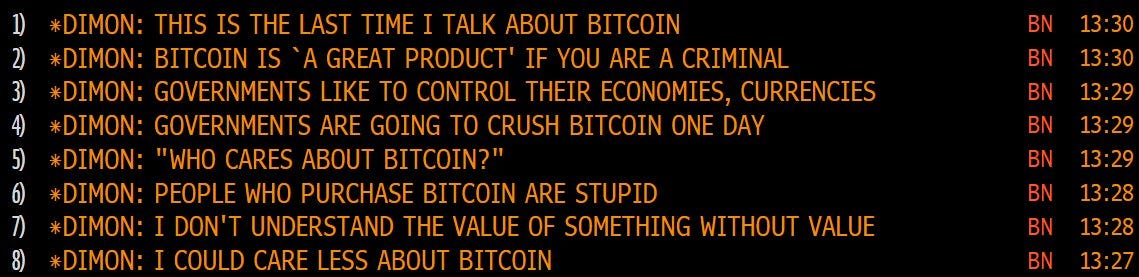
Last week you said a few things about Bitcoin:

Bloomberg. https://twitter.com/joelight/status/918899226771427328

It's easy to believe cryptocurrencies have no inherent value. Or that governments will crush them.
It's also becoming fashionable to believe the opposite: that they will disrupt banks, governments, and Silicon Valley giants once and for all.
Neither extreme is true.
The reality is nuanced and important. Which is why I've decided to write you this briefing note. I hope it helps you appreciate cryptocurrencies more deeply.
Let me start by stating that I believe:
  • The market for cryptocurrencies is overheated and irrationally exuberant
  • There are a lot of poseurs creating them, and some scammers, too
  • There are a lot of conflicts of interest, self-serving hype, and obfuscation
  • Very few people in the media understand what's going on
  • Very few people in finance understand what's going on
  • Very few people in technology understand what's going on
  • Very few people in academia or government understand what's going on
  • Very few people buying cryptocurrencies understand what's going on
  • It's very possible I don't understand what's going on
Also:
  • Banks and governments aren't going away
  • Traditional software isn't going away
In short: there's a lot of noise. But there is also signal. To find it, we need to start by defining cryptocurrency.
Without a working definition we are lost. Most people arguing about cryptocurrencies are talking past each other because they don't stop to ask the other side what they think cryptocurrencies are for.
Here's my definition: cryptocurrencies are a new asset class that enable decentralized applications.
If this is true, your point of view on cryptocurrencies has very little to do with what you think about them in comparison to traditional currencies or securities, and everything to do with your opinion of decentralized applications and their value relative to current software models.
Don't have an opinion on decentralized applications? Then you can't possibly have one on cryptocurrencies yet, so read on.
And since this isn't about cryptocurrencies vs. fiat currencies let's stop using the word currency. It's a head fake. It has way too much baggage and I notice that when you talk about Bitcoin in public you keep comparing it to the Dollar, Euro, and Yen. That comparison won't help you understand what's going on. In fact, it's getting in the way. So for the rest of this note, I will refer to cryptocurrencies as crypto assets.
So, to repeat: crypto assets are a new asset class that enable decentralized applications.
And like every other asset class, they exist as a mechanism to allocate resources to a specific form of organization. Despite the myopic focus on trading crypto assets recently, they don't exist solely to be traded. That is, in principle at least, they don't exist for their own sake.
To understand what I mean, think about other asset classes and what form of organization they serve:
  • Corporate equities serve companies
  • Government bonds serve nations, states, municipalities
  • Mortgages serve property owners
And now:
  • Crypto assets serve decentralized applications
Decentralized applications are a new form of organization and a new form of software. They're a new model for creating, financing, and operating software services in a way that is decentralized top-to-bottom. That doesn't make them better or worse than existing software models or the corporate entities that create them. As we'll see later, there are major trade-offs. What we can say is simply that they are radically different from software as we know it today and radically different from the forms of organization we are used to.
How different? Imagine the following: you grew up in a rainforest and I brought you a cactus and told you it was a tree. How would you react? You'd probably laugh and say it's not a tree because there's no point in a tree being a stumpy water tank covered in armor — after all, water is abundant here in the rainforest! This, roughly, is the reaction of many people working in Silicon Valley to decentralized applications.
But I digress. I owe you an important explanation:
What is a decentralized application?
A decentralized application is a way to create a service that no single entity operates.
We'll come to the question of whether that's useful in a moment. But first, you need to understand how they work.
Let's go back to the birth of this idea.

Tuesday, December 12, 2017

This is a joyless bubble Anyone questioning whether financial markets are in a bubble should consider what we witnessed in 2017

John Mauldin shows us the absurdity of this market. 

• A painting (which may be fake) sold for $450 million.

• #Bitcoin (which may be worthless) soared nearly 700% from $952 to ~$8000 (Nb : since this was written 2 weeks ago, it's now more than double that...).

• #QE: The Bank of Japan and the European Central Bank bought $2 trillion of assets.

• Global #debt rose above $225 trillion to more than 324% of global GDP.

• US corporations sold a record $1.75 trillion in bonds.

• European #highyield bonds traded at a yield under 2%.

• #Argentina, a serial defaulter, sold 100-year bonds in an oversubscribed offer.

• Illinois, hopelessly insolvent, sold 3.75% bonds to bondholders fighting for allocations.

• Global stock market capitalization skyrocketed by $15 trillion to over $85 trillion and a record 113% of global GDP.

• The market cap of the #FANGs increased by more than $1 trillion.

• S&P 500 #volatility dropped to 50-year lows and Treasury volatility to 30-year lows.

• Money-losing @Tesla Inc. sold 5% bonds with no covenants as it burned $4+ billion in cash and produced very few cars.

This is a joyless bubble, however. It is accompanied by political divisiveness and social turmoil as the mainstream media hectors the populace with fake news. Immoral behavior that was tolerated for years is finally called to account while a few brave journalists fight against establishment forces to reveal deep corruption at the core of our government (yes, I am speaking of Uranium One and the Obama Justice Department). In 2018, a lot of chickens are going to come home to roost in Washington, D.C., on Wall Street, and in the media centers of New York City and Los Angeles. Icons will be blasted into dust as the tides of cheap money, cronyism, complicity, and stupidity recede. Beware entities with too much debt, too much secrecy, too much hype. Beware false idols. Every bubble destroys its idols, and so shall this one

5 Charts That Show We Are on the Brink of an Unthinkable Crisis 
John Mauldin on LinkedIn


Monday, January 9, 2017

#Bitcoin & #China

Bitcoin seems to have become the preferred method for capital flight out of China. 


Below is a text from Armstrong Economics about Bitcoin and China.

We attached a 2-year chart of the price of Bitcoin.


"The rally in bitcoin has come out of China, which has accounted for 98% of bitcoin trading in the past six months. China is also home to about two-thirds of the world's bitcoin mining power. The Phase Transition spike in bitcoin is very alarming, for it flies right in the face of government attempts to eliminate currency. The Chinese have been buying bitcoin onshore, selling it offshore for another currency, and then moving the money to a bank account. This is how the Chinese individuals can take cash out of the country, circumventing all regulation.

The Chinese government has been strengthening requirements for citizens by converting their yuan. With Trump coming into office, China fears that lower values for the yuan will become a trade war even if the government is not actively trying to depreciate the yuan for trade. Conversions of yuan are already subject to a quota or currency controls in an effort to curb capital outflows.

Bitcoin has been the escape method for capital fleeing China. With the looming trade war on the horizon, the Chinese government will have absolutely NO CHOICE but to come in and regulate bitcoin as its citizens now account for 98% of all trading. From a regulatory perspective, the days of passive treatment of bitcoin may come to an end. Bitcoin has soared only because it has been the mechanism to obtain foreign exchange and take capital out of China. This could easily be considered an illegal operation, such as money laundering, to justify closing that window.

Of course, you have the zealots who preach bitcoin as the alternative to the dollar that they cannot shut down. All they need to do is declare bitcoins illegal and the PRESUMPTION of being in bitcoin is a PRESUMPTION of being a criminal. They are already using terms like "CASH IS FOR CRIMINALS" and if you have a few thousand in cash, they just confiscate it presuming you are criminal under Civil Asset Forfeiture without having to prove you committed a crime or charging you.

Keep in mind we are dancing with the devil. There are no rules — just ruthless self-interest. They will do whatever it takes to survive. They will not relinquish power willingly".


Thursday, April 4, 2013

CORRECTION FROM ABN #AMRO RE: ABN AMRO #defaults on physical #gold deliveries to customers

Its seems that the actual situation is quite different.  There has not been a default from ABN AMRO. 

CORRECTION WITH STATEMENT FROM ABN AMRO:
There has recently been misguided reporting in the media concerning a letter sent by us to a small number of Dutch clients regarding our gold banking services. We are seeking to clarify this misunderstanding with the following information:

Until 2009 ABN AMRO had a small bank that traded in physical gold called Hollandse Bank Unie (HBU) located in Rotterdam. Following our integration with Fortis Bank Netherlands, ABN AMRO was required by the European Commission to sell a part of its commercial banking portfolio in the Netherlands to Deutsche Bank. This was publicly announced at the time and included the sale of HBU, along with the transfer of HBU clients to Deutsche Bank. These HBU clients were able to use ABN AMRO facilities during the transition phase, and Deutsche Bank also offered its HBU services to ABN AMRO. Deutsche Bank subsequently announced last year that they would cease HBU activities in the Netherlands from 1 April 2013 – including this facility for ABN AMRO. We recently sent a letter to small number of affected clients, advising them that we can no longer make use of the HBU facilities provided by Deutsche Bank from this date. We have also found a new provider for these service, that is UBS.

If you require any further information, please contact the ABN AMRO press office
Jeroen van Maarsschalkerweerd +31 20 628 4748
Alex Evans                               +44 20 3192 9417


Alex Evans | Senior International Press Officer
ABN AMRO Bank N.V., UK Branch
This was the Original Post:

Is this the Canary in the Coal Mine?
ABN AMRO issued a letter to their gold contract customers of failure of delivery, and instead will pay account holders in a paper currency equivalent
 Largest Dutch bank defaults on physical gold deliveries to customers - National Finance Examiner | Examiner.com 

Last week, a rubicon was crossed in the precious metals market as one of the largest banks in Europe defaulted on their gold contracts, and informed their customers there was no physical gold available for delivery.
ABN AMRO, the largest Dutch bank in the Eurozone, issued a letter to their gold contract customers of failure of delivery, and instead will pay account holders in a paper currency equivalent to the current spot value of the metal.
Over the past two months, there has been a concerted effort by the major Western banks to bring down the price of gold and silver, even as countries like Russia, Iran, and China continue to accumulate the physical metal in large quantities. Like the folly of betting against the stock markets when the Fed is pumping up equities with $85 billion per month, going against the J.P. Morgan silver short machine in the futures market has been a losing proposition for silver bulls.
Interestingly for Europe however, since the Eurozone crisis spread from Greece to Spain, Italy, and Cyprus, the fastest growing currency being purchased by retail investors is Bitcoin. Bitcoin is a digital currency that is out of the control of sovereign central banks, and to this point, has not been manipulated by inflationary monetary policy.
In investing circles there is an adage which says, if you don't hold it, you don't own it. Whether it is land, metals, or other hard assets, if it is held in a bank, in a paper instrument, or in a paper currency, the documented owner has management control, but not physical control. And as the world saw last month in Cyprus, the government, or even a major bank like ABN AMRO, can change the terms of a contract at any time, and return to investors asset values set by the bank, and not the customer's intention.

Read the article online here: Largest Dutch bank defaults on physical gold deliveries to customers - National Finance Examiner | Examiner.com