Follow us on Twitter

Showing posts with label Commodities. Show all posts

Monday, December 21, 2020

#Commodities Back In Play as Investors Get Ready for Next Boom


“It’s highly probable that a great many investors will look back on 2020 and wonder how they missed these signs of a new commodity bull market.”
  • Prices have surged to highest in more than six years
  • Inflation fears are drawing investors back to resources sector

For the best part of a decade, commodities have been deeply out of fashion. Now, as investors scour the market for the great reflation play, they’re hot again.

Investing luminaries from Point72 to Pimco are calling for commodity prices to move higher. Goldman Sachs Group Inc., the bellwether of Wall Street, is predicting a new commodity bull market to rival the China-driven boom of the 2000s and the oil price spikes of the 1970s.

“We very much believe that the fundamentals are now in place for a new, structural, bull market to begin,” said Robert Howell, senior research strategist at Gresham Investment Management LLC, the commodities-focused unit of Nuveen with $5.8 billion in assets in the sector. “In the years to come, it’s highly probable that a great many investors will look back on 2020 and wonder how they missed these signs of a new commodity bull market.” 


________________________

Thursday, September 24, 2020

Another One Bites The Dust… BNP Shuts Swiss #Commodities #TradeFinance Team—A Sector it Helped Pioneer—After Series of Frauds

BNP Paribas SA is shutting its Swiss commodity trade finance business, exiting a sector it once dominated but has been hit by a series of massive frauds.

The former Paribas investment bank's office in Geneva helped pioneer the use of letters of credit to finance oil trading in the 1970s, and became one of the leading lenders to the industry. However, BNP Paribas had been shrinking in commodity trade finance since 2014, when it was fined $8.9 billion for violating U.S. sanctions.

The plan could impact as many as 120 employees in its Geneva offices, the French bank said in a statement late Tuesday. 

Read the whole story on Bloomberg: https://www.bloomberg.com/news/articles/2020-09-23/bnp-shuts-swiss-commodity-trade-finance-team-in-fraud-hit-sector


____________________


Monday, May 20, 2019

Wednesday, March 20, 2019

'Trade of Century': Buy #Gold, Sell Stocks (like Insiders are doing) before Recession Comes & Markets Drop

Crescat Capital Says Buy Gold, Sell Stocks in `Trade of Century' - Bloomberg


Buy Gold, Sell Stocks Is the 'Trade of Century' Says One Hedge Fund

One of last year's best-performing hedge funds says the "trade of the century" is to buy gold and sell stocks as risk assets are due for another meltdown.
It's only a matter of time until the bearish bet pays off big, according to Crescat Capital LLC. While the Denver-based firm has only about $50 million under management, it has a history of outperforming the S&P 500 Index -- with its Global Macro Fund returning 41 percent last year alone. Now the investment company says it's ready to capitalize on an end of the economic cycle as indicators warn that a recession is imminent in the coming quarters.
The consensus is pointing to a recession in 2020 or 2021, Tavi Costa, a global macro analyst at Crescat, said by phone. "We think it's a lot closer than that and we have a number of macro timing indicators that we look at."

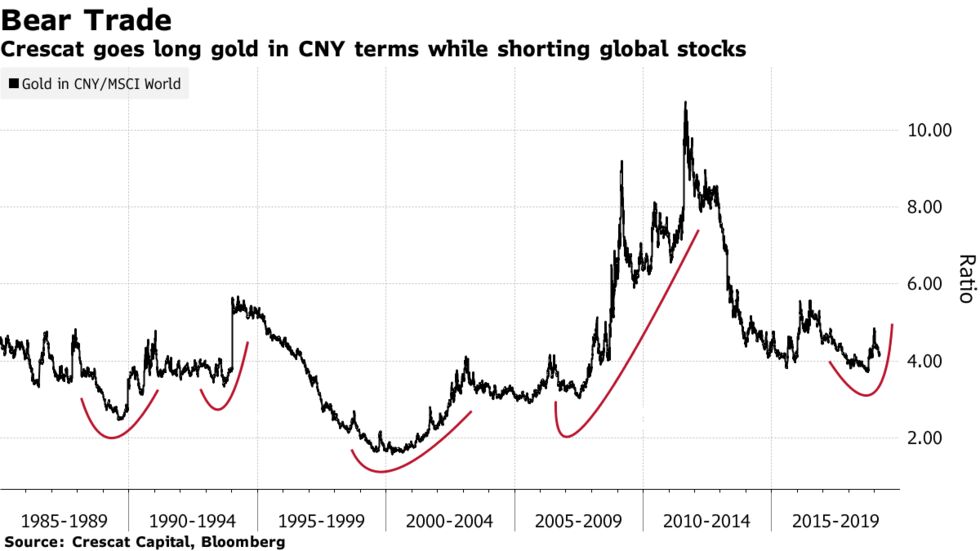
Crescat goes long gold in CNY terms while shorting global stocks

Going long gold in yuan terms and shorting global equities currently explains three-quarters of the hedge fund's strategy. While the firm uses the MSCI World Index in models to visualize the trade, it goes a bit deeper with its short position, selecting individual stocks and exchange-traded funds to bet against.

Monday, October 15, 2018

#Energy traders and banks back new #blockchain platforms

Energy traders and banks back new blockchain platforms | Financial Times

Royal Dutch Shell, Mercuria and Gunvor, and financial institutions such as ING, Société GénéraleCitigroup and ABN Amro are backing two new blockchain platforms.

By digitising the large amount of contracts, letters of credit, invoices and other paperwork currently sent around the world by email, fax or post, and putting them on the Ethereum blockchain platform, they are hoping that the new platforms will lead to faster, cheaper and more secure ways of completing a trade as well as settling the transaction


Energy traders and banks back new blockchain platforms

Aim is to provide faster, cheaper and more secure ways of completing trades

A group of the world's leading energy traders and banks is looking to shake up the centuries-old trade finance industry with the launch of two new platforms underpinned by blockchain technology.

Friday, March 24, 2017

After years of underinvestment, #Miners set to massively increase spending in #Exploration Hunt - Bloomberg

Miners Regain Mojo to Spark $18 Billion in Exploration Hunt - Bloomberg
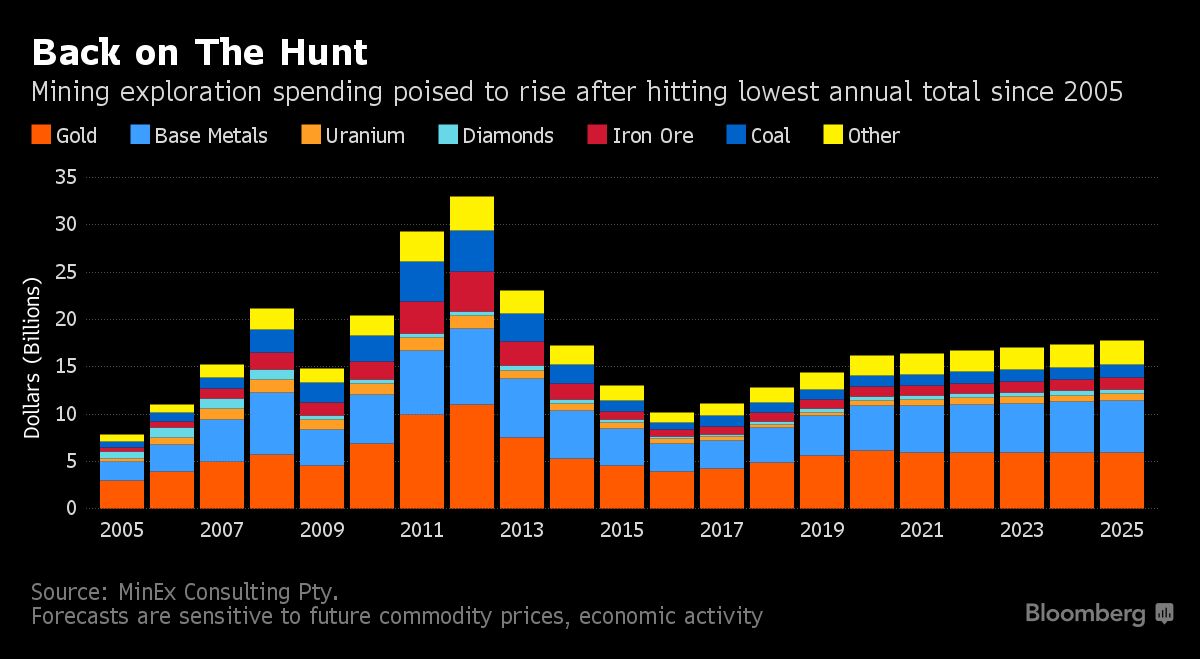
  • Exploration Spending forecast to rise more than 75% through 2025 to $18 Billion: MinEx
  • Discovery of world-class deposits has slowed in past decade
https://www.bloomberg.com/news/articles/2017-03-23/miners-regain-mojo-to-spark-18-billion-in-global-exploration


Miners Regain Mojo to Spark $18 Billion in Exploration Hunt

by
David Stringer

  • Spending forecast to rise more than 75% through 2025: MinEx
  • Discovery of world-class deposits has slowed in past decade
A rebound in exploration by global miners could see spending hit $18 billion by 2025 with China the front runner in the search for a new generation of giant discoveries.
Exploration budgets are rising after they plunged to an 11-year low of about $10 billion last year as mining companies slashed costs in the wake of a collapse in prices, according to Richard Schodde, managing director of Melbourne-based MinEx Consulting Pty, an industry adviser.
"We are coming out of the bottom of the cycle. I actually see the opportunity for the exploration sector to regain its mojo and quickly deliver a pipeline of good discoveries," Schodde said in an e-mailed response to questions. "It's catch-up time for the industry."


China, the top spender on exploration, is likely to continue to dominate in the hunt for new deposits, while Canada and Ecuador are currently among hot targets for more investment by miners, according to Schodde. The U.S. could be poised for a rise in exploration with President Donald Trump regarded as likely to be more favorable toward resource development, S&P Global Market Intelligence said in a report published in January.
Discoveries of so-called tier one projects, deposits with a net present value of more than $1 billion, have stalled. Only 12 were uncovered in the past decade compared to an average of two to three a year since 1950, according to MinEx. The average cost of finding a significant mineral deposit has tripled in the last 10 years to about $238 million, the consultancy said in a March 6 presentation.
China, the target of more than a quarter of global exploration spending in 2016, is yet to reap major rewards. An estimated $42 billion spent on the nation's hunt for new mines since 2007 has seen only two large discoveries announced and found a total slate of projects worth about $13 billion, according to MinEx. Global exploration budgets peaked in 2012 at $33 billion, the data show.

Thursday, March 31, 2016

Standard Chartered Closes #Geneva #Commodities Office Amid Oil Rout


Move leaves bank without a physical presence in city home to the world's largest oil & commodity traders.

Commodity desk set to be moved to London.

Bloomberg reports:

Standard Chartered Closes Geneva Commodity Office Amid Oil Rout

Standard Chartered Plc is closing its office in Geneva, the global center of the commodity-trading industry, in Chief Executive Officer Bill Winters's latest move to slash the lender's exposure to the oil, gas and agricultural industries.
While the bank says commodities trading and agribusiness, or CTA, will continue to be a "core activity," it will be transferred to London as "a consequence of our decision to reduce our overall exposure to commodity-related clients," the bank said in a statement in response to questions. Closing the Geneva office, which opened in 2007, "marks the end of Standard Chartered's client coverage from Switzerland," it said.
The move leaves Standard Chartered without a physical presence in a city home to the world's largest oil traders, including Vitol Group and Mercuria Energy Group Ltd. Traders accounted for $20 billion of Standard Chartered's $40 billion commodity exposure last year, down from $33 billion during 2014, according to its annual report.


Plunging Oil

Winters is undertaking a root-and-branch overhaul of the struggling firm, which made its first annual loss in more than a quarter of a century last year. The CEO had to raise $5.1 billion of capital to shore up its balance sheet amid spiraling losses from loans made during the commodity boom, and has also replaced its entire senior management team while pledging to cut 15,000 jobs and restructure or ditch about $100 billion of assets.
Since mid-2014, the lender has reduced its exposure to commodities by about a third, company filings show, as the price of oil plunged by more than 50 percent from more than $100 a barrel to less than $40. It had $20.4 billion of total exposure to traders at the end of last year, about 8 percent of its $261 billion of loans.
"The key risk for traders, which are less directly affected by price changes, is lack of liquidity and their risk-management practices," the bank said in its annual report. Loan impairments almost doubled to $4 billion in 2015, the highest ever.
While oil and gas accounts for the lion's share of Standard Chartered's natural resource exposure, Winters's review has drilled down as far as its tiny $2 billion diamond portfolio, where he's demanding that borrowers find insurance, provide collateral or repay their debts.

Monday, November 2, 2015

Bank of China looking to set up a Trade & Commodity Finance operation in Geneva Agefi.com

Wang Min, responsible for international trade services at Bank of China, said they are looking to set up once more in Geneva.  Read the whole article on the Agefi.com website - in French.

Les synergies sino-suisses | Agefi.com

Wednesday, September 30, 2015

#Glencore just the tip of the iceberg? @Zerohedge takes a look at #Trafigura, #Mercuria coming next....

Financial Crisis Alert: Black Swans Are Circling The Commodity Pits

Back in July, long before anyone was looking at Glencore (or Asia’s largest commodity trader, Noble Group which we also warned last month was due for a major crash, precisely as happened overnight) which everyone is looking at now that its CDS is trading points upfront and anyone who followed our suggestion last March to go long its then super-cheap CDS can take a few years off, we had a rhetorical question:

Which will be first: Trafigura, Mercuria or Glencore

— zerohedge (@zerohedge) July 22, 2015

Judging by what happened less than two months later, it appears that we have our answer: for now at least, Glencore, which is now flailing and which Bloomberg reported moments ago is set to meet with its bond investors tomorrow (supposedly to allay their fears of an imminent insolvency), is firmly the “answer” to our rhetorical question.

And yet, something stinks.

First, a quick look at Trafigura bonds reveals that the contagion from the Glencore commodity-trader collapse, which “nobody could possibly predict” two months ago and which has rapidly become the market’s biggest black swan, has spread and we now have a new contender. And while Trafigura’s equity is privately held, it does have publicly-traded bonds. They just cratered:

… sending the yield soaring to junk-bond levels.

As discussed below, this may just be the beginning for the company which, because it does not have publicly traded equity – but has publicly traded debt – has so far managed to slip under the radar.

But who is Trafigura? Only the world’s third largest private commodity trader after Vitol and Glencore. 

From the company’s own description:

Trafigura is one of the world’s leading independent commodity trading and logistics houses. We’re at the heart of the global economy. Every day and around the world, we are advancing trade – reliably, efficiently and responsibly. We see global trade as a positive force and we go further to make trade work better.

More important than some pitchbook boilerplate, is the company’s history: Trafigura was formed in 1993 by Claude Dauphin and Eric de Turckheim when It split off from a group of companies managed by Marc Rich, aka “the king of oil” in 1993.

Who is March Rich? Why the founder of Glencore of course who as a reminder, was indicted in 1983 on 65 criminal counts including income tax evasion, wire fraud, racketeering, and trading with Iran during the oil embargo. Upon learning his prison sentence may be as long as 300 years, Rich promptly fled to Switzerland; he was so afraid of US authorities, he even skipped his daughter’s funeral in 1996.

Marc Rich got a presidential pardon from Bill Clinton in a decision which was blessed by the kingpin of corruption, former DOJ head Eric Holder.  Clinton himself later expressed regret for issuing the pardon, saying that “it wasn’t worth the damage to my reputation.

But back to Trafigura, whose summary financials reveal that the company – with $127.6 billion in revenues in 2014 and $39 billion in assets – is absolutely massive. In fact, in terms of turnover, it is virtually the same size as Glencore.

But the most important and relevant numbers are on neither of the pretty annual report grabs above. They are highlighted in red in the excerpt from the company’s interim report: the $6.2 billion in non-current debt and $15.6 billion in current debt for a grand total of 21.9 billion in debt!

Now, this is less than Glencore’s $31 billion (the implication being that Trafigura has a solid $6 billion equity cushion although judging by the bond plunge the market is starting to seriously doubt this) but the problem is that Trafigura’s EBITDA is lower. Much lower. 

According to CapIq, Trafigura had $1.8 billion in LTM EBITDA, suggesting a debt/EBITDA leverage ratio of a whopping 12x. If one wants to be generous and annualizes the company’s disclosed 6-month EBITDA (for the period ended 3/31/2015) of $1.1 billion, the EBITDA grows to $2.2 billion. This lowers the debt/EBITDA for Trafigura to “only” 10x.

Indicatively, Glencore’s own debt/EBITDA, and the reason for so much conerns about the company’s solvency, is about half of Trafigura’s.

At least on the surface, it appears that Trafigura, which is as reliant on the ups and down of commodity trading as Glencore, is far more levered, and exposed, to any commodity crush than the Swiss giant.

But what really set off our alarm bells, is that a quick skim through the company’s annual report reveals something disturbing: a commissioned report titled “Too Big To Fail: Commodity Trading Firms and Systemic Risk” whose purpose was to explain why, as the title implies, commodity trading firms are not systemically important. The timing, just months before a historic rout for commodity traders, is odd to say the least.

As a general take, any time someone first brings up, and then tries to talk down the impact of something as being “Too Big To Fail”, run.

More seriously, there are two problems with this analysis: as events in the past week have shown, commodity trading firms clearly carry a systemic risk: after all, one after another news outlet rushed to explain why yesterday’s market plunge was the result of Glencore fears. It would have been the same with Trafigura’s equity plunge… if the company had publicly-traded equity instead of just debt.

The second problem is the subheader to the paper:

Trafigura commissioned a white paper this year on commodity trading firms and systemic risk. Its author, Craig Pirrong, explains why he believes these firms are unlikely to have a destabilising effect on the global economy.

The paper’s conclusion: “Commodity trading firms are not a source of systemic risk.

Oops.

Who is Craig Pirrong? As the NYT explained in a 2013 article titled “Academics Who Defend Wall St. Reap Reward“, Pirrong, a University of Houston professor, is just a member of that all too pervasive “paid expert for hire” group, academics without actual credibility inside their own circles, and who as a result will “opine” on anything and everything – usually involving Wall Street regulatory and “risk” matters, just to get paid.

This is precisely what Trafigura did when it commissioned him to “explain” why Trafigura is not systemic. Ironically it did so in August, just as all hell was about to break loose for the commodity traders, especially the most systemic ones.

And while the market has shown how the paid opinions of such “experts for hire” should be completely ignored, the question remains: just what was Trafigura so concerned about when it commissioned a well-compensated study meant to goal-seek the company’s explicit conclusion: that it is not systemic, when it obviously is.

Opinions aside, at the end of the the market will decide just who is systemic and who isn’t. One look at the price of Trafigura’s bonds above has given us the answer: it is a move comparable to what happened to Lehman bonds – if not equity – the day after the bankruptcy filing.

Clearly the Lehman bonds could not believe what just happened until it was too late. For Glencore, and increasingly Trafigura, the bond price is finally signalling the realization that “this is indeed happening.”

* * *

We’ll save our discussion of Mercuria for another day.

Source: Forget Glencore: This Is The Real “Systemic Risk” Among The Commodity Traders | Zero Hedge