Follow us on Twitter

Thursday, August 20, 2020

#Gold is the Natural Alternative Currency Amid Massive Debasement Globally by Central Banks

Gold to Gain on Massive Currency Debasement, SkyBridge Says - Bloomberg
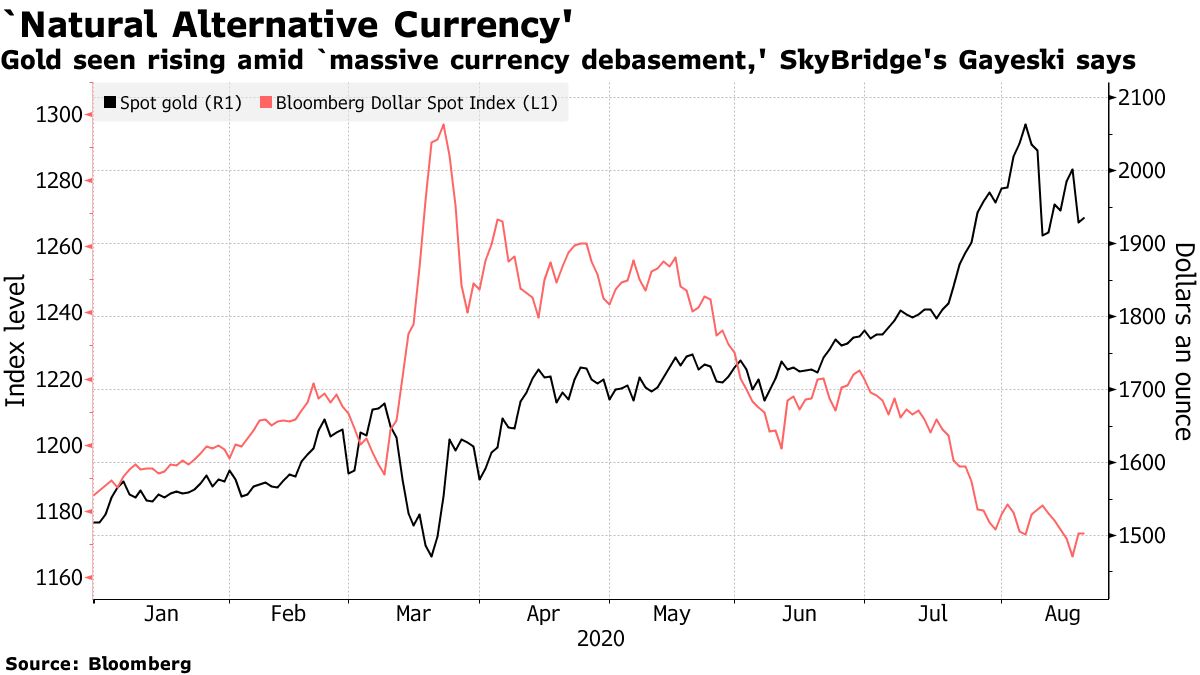
Gold seen rising amid `massive currency debasement,' SkyBridge's Gayeski says
Gold to Gain on Massive Currency Debasement, SkyBridge Says

Gold will extend its record-setting rally on "massive currency debasement" and expectations for further stimulus, according to SkyBridge Capital, which recently added exposure to the metal after exiting in 2011.

"When you think of currency debasement the question is, what is the dollar going to weaken against, and when you look around the globe, it's hard to be excited about alternative currencies," said Troy Gayeski, co-chief investment officer and senior portfolio manager, listing the euro, yuan and emerging-market monies. "So, gold is obviously a natural alternative currency." 

The precious metal surged to a record well above $2,000 an ounce earlier this month -- although prices have stumbled since then -- as central banks including the Federal Reserve unleashed vast stimulus to support economies hurt by the coronavirus pandemic. That's spurred bets that paper currencies will lose their value as money supply jumps. Goldman Sachs Group Inc. calls gold the currency of last resort and has forecast more gains.

Gold is "fairly rich versus oil or other real commodities, but it hasn't appreciated nearly as much as money-supply growth since its previous peak in September of 2011," Gayeski said in an interview. "It wouldn't surprise us if by the end of next year, it's around the $2,100-to-$2,200 range."

Spot gold hit an all-time high of $2,075.47 an ounce on Aug. 7 as the dollar weakened and real interest rates fell well below zero. On Thursday it climbed 0.4% to $1,936, up almost 28% this year. Prices eased midweek after minutes from the Fed showed it edging away from a step that would underscore a commitment to an extended period of ultra-loose policy.

Ultimately, the driver for gold is "you have massive currency debasement, particularly in the U.S.," Gayeski said.

SkyBridge, which manages $7.35 billion, has about 3% exposure to gold, with the majority of positions taken in the past two months. The fund-of-funds manager's primary exposures are to U.S. cash-flow-generative strategies backed by tangible assets, including residential mortgage-backed securities.

While the latest round of fiscal stimulus talks haven't yet yielded a deal, the Fed has already swelled its balance sheet by about $2.8 trillion this year, with Goldman cautioning that U.S. policy is triggering debasement fears.

The Fed will likely ramp up asset purchases, and there's more fiscal stimulus coming too, according to Gayeski. "All those things argue for a continued bull market in gold, again driven principally by money-supply growth and dollar debasement as opposed to real inflation fears," he said. "Furthermore, expect continued asset inflation long before real inflation ever shows up."

See the article on Bloomberg here: https://www.bloomberg.com/news/articles/2020-08-20/gold-will-gain-on-massive-currency-debasement-skybridge-says?

Related coverage and commentary:


https://bit.ly/PangeaBlog 


Wednesday, August 12, 2020

#Gold seeming to offer something for everyone, is yet another unintended result of the exceptional liquidity from central banks in their quest to manipulate the functioning of markets

Gold's evolution into a 'must-have' asset is storing up trouble
That gold is seen to offer something for everyone is yet another unintended result of the exceptional involvement of central banks in the functioning of markets
© Leonhard Foeger/Reuters 
After rising 17 per cent in the first half of the year, gold prices surged to record highs before retreating on Tuesday to just below $2,000. In the process, investors went from treating gold as a short-term momentum trade to seeing it more as a legitimate standalone option in long-term portfolios. You need only look at real yields on government bonds after adjusting for inflation to see why so many investors are buying gold as a long-term option.

Gold's evolution into a 'must-have' asset is storing up trouble

Price rise is being driven by investors adding the metal to long-term portfolios

The writer is Allianz's chief economic adviser and president-elect of Queens' College, University of Cambridge

Until recently, the rapid rise in the price of gold had more to do with opportunistic financial trading than any larger structural investment theme, let alone a drop in physical supply or an increase in industrial use.

Now, the metal is seen to offer something for everyone. That is yet another unintended result in a lengthening list of the exceptional involvement of central banks in the functioning of markets. Their expanded interventions to counteract the effects of the pandemic have pleased many now but will create problems for the central banks and the economy at large, if a sharp and lasting economic recovery continues to elude us.

After rising 17 per cent in the first half of the year, gold prices surged to record highs before retreating on Tuesday to just below $2,000. In the process, investors went from treating gold as a short-term momentum trade to seeing it more as a legitimate standalone option in long-term portfolios. You need only look at real yields on government bonds after adjusting for inflation to see why so many investors are buying gold as a long-term option.

Contrary to what most textbooks would suggest, the recent drop in nominal yields has coincided with a rise in inflationary expectations. This makes gold a more attractive substitute for government bonds in two ways. Investors who opt for gold forgo less income than they would if bond yields were higher. They also hedge against what would be a dramatic loss in the value of those bonds, should central banks stop trying to keep interest rates low by flooring official rates and buying massive amounts of market securities.

Gold is also proving compelling for other reasons, collecting quite an unlikely cast of backers in addition to the usual bugs who worry about currency debasement and geopolitical shocks. Some believe it will protect investors against further depreciation of the US dollar; others want it as a hedge against a global economic depression and a collapse in stock markets that, already, are stunningly decoupled from corporate and economic realities. Today's gold camp even manages to attract those looking to protect against competing outcomes: deflation and inflation. 

Gold is not the only asset to have developed this multiple and seemingly bipolar personality. Big Tech stocks have also been seen as offering everything to everybody. They promise growth based on the shift from physical to virtual activities in the pandemic, but also downside protection because they have massive cash holdings, low debt and positive cash-flow generation. The collapse in nominal yields on government and safe corporate bonds is also leading some investors to ask whether non-investment grade "junk" bonds can be a safe place to park their money.

Underpinning these contradictory developments is investor faith that central banks will protect them from big losses by continuing to intervene whenever markets slide. Gold is evolving into a "must-have" asset. That drives the price upwards as the pool of potential buyers shifts from a small group of quirky bugs to the much larger pool of investors seeking risk mitigation. Like many sudden structural shifts, it is likely to involve an initial price overshoot.

Think of this as part of a broader shifting baseline. Investors are treating an ever growing number of traditionally risky assets as low risk, or even hedges against risk. In the short term, this pushes prices higher, reinforcing the attitude change and lulling politicians and central bankers into believing that the market cycle has been conquered. But they are likely to prove as wrong as those who, before the 2008 financial crisis, erroneously believed they had vanquished the business cycle.

Tuesday, August 11, 2020

Pangaea With Current International Borders – Brilliant Maps

Pangaea With Current International Borders – Brilliant Maps
Pangaea Map With Current International Borders
Map originally created by Massimo at MI LABORATORIO DE IDEAS
Pangaea With Current International Borders


The map above is one of my all time favourites. It shows Pangaea, a supercontinent that existed from 300 million to 175 million years ago, with modern international borders.

Needless to say it would make international relations a little bit more complicated. Major changes include:

  • The United States now borders a few new countries including Morocco, Mauritania, Senegal and Cuba.
  • Spain now has a land border with Algeria.
  • Italy now borders Tunisia.
  • Greece borders Libya.
  • Brazil borders a whole bunch of new states from Namibia in the south to Liberia in the north.
  • India now finds itself in the southern hemisphere, right next to Antarctica.
  • You could walk from Australia to Tibet (which is no longer attached to China).
  • While China has lost Tibet it has gained a massive amount of new coast line.

Notice anything else that might complicate international politics? Then please, leave a comment in the comment section below.

Update: You can now play around with a fully Interactive Pangaea Map With Modern International Borders here.

https://brilliantmaps.com/pangaea/ 


Monday, August 10, 2020

What’s with #Gold Backwardation? @FTAlphaville’s @IzaKaminska tackles the question

"when regular money rates become negative, however, gold's zero yielding quality is no longer construed as a vice but rather a feature. In such circumstances, holding cash becomes costly while holding gold becomes the opportunity. And it's this feature which triggers not just demand for new sources of gold, but also a backwardation that incentivises those who have previously stashed gold to sell out at a profit."

Read the whole piece here: http://ftalphaville.ft.com/2020/08/05/1596631139000/What-s-with-gold-backwardation-/


Bit.ly/PangeaBlog
Bit.ly/PangeaFeeds


Tuesday, July 28, 2020

.@GoldmanSachs Warns US #Dollar's Role Is at Risk as #Gold Prices Surge - Bloomberg

#Gold's record-breaking rally highlights growing concern over the world economy.

Goldman raised its 12-month forecast for gold to $2300 an ounce from $2000 an ounce previously. That compares with a value of around $1950 currently.

The bank sees U.S. real interest rates continuing to drift lower, boosting gold further.


________________________