Follow us on Twitter

Friday, July 20, 2018

Is #Cobalt Still Essential to Battery Technology?

Is Cobalt Still Essential to Battery Technology? | Investing News Network
"#Cobalt is the element that makes up for the lack of stability of Nickel. There isn't a better element than nickel to increase energy density, and there isn't a better element than cobalt to make the stuff stable."
https://investingnews.com/innspired/is-cobalt-still-essential-to-battery-technology/

Is Cobalt Still Essential to Battery Technology?

Cobalt is still in the driver seat for electric vehicle, consumer electronics and energy storage markets.

Cobalt's role as a critical material in the booming electric vehicle (EV) batteries market has been the key driver of the cobalt story—pushing prices up four-fold from 2016 to a peak of US$93,250 per tonne in April 2018, compared to US$13,300 per tonne for lithium.

On the supply side, more than half of the world's output comes from the politically-unstable Democratic Republic of the Congo (DRC) where child labor and inhumane working conditions have drawn warranted scrutiny from conscientious consumers demanding conflict-free products.

High prices and supply security concerns have led both Tesla's Elon Musk and global battery manufacturer Panasonic to announce they're tweaking the chemical composition of their batteries to remove cobalt from the equation. This may seem like a serious impediment to cobalt's future; however, there is more to the cobalt's supply and demand story and the metal still has a significant role to play in the future of both battery and electronics markets.

 This INNspired Article is brought to you by:

eCobalt (TSX:ECS; OTCQX:ECSIF; FRA:ECO) is a resource company advancing its Idaho Cobalt Project ("ICP") towards near-term production with the aim of producing clean cobalt concentrate, a key material in battery cathodes.Send me an Investor Kit

Cobalt critical to cathode chemistry

Energy in lithium-ion batteries is stored in the cathode, which is made by forming a base metal oxide skeleton with lithium ions embedded inside the skeleton. It is the base metals used in the cathode chemistry which determines the cost and performance of the battery.

The preferred chemistries for most EV manufacturers have been lithium-nickelmanganese-cobalt oxide (NMC) and lithium-cobalt-aluminum (NCA) batteries. Compared to other chemistries, these are considered to be the most efficient in terms of both power and energy storage. The standard recipe for NMC batteries consists of 60 percent nickel, 20 percent manganese and 20 percent cobalt.

"Cobalt is the element that makes up for the lack of stability of nickel, according to Umicore Chief Executive Marc Grynberg. "There isn't a better element than nickel to increase energy density, and there isn't a better element than cobalt to make the stuff stable."

Cobalt an essential material for modern life

Cobalt is a relatively stable element with high-density conductive and non-corrosive properties that make it ideally suited to more than just EV batteries. In fact, in 2017, about 72 percent of the world's annual cobalt consumption went to the mobile device market—think cell phones, laptops, and tablets as well as a wide range of consumer electronics such as portable tools and home appliances; the everyday essentials of life in the modern world.

Not only is cobalt used in the rechargeable batteries that power these devices, the metal is also an integral part of electrical components such as semiconductors and integrated circuits. Cobalt can be found in the circuitry of home appliances, and coats the copper wiring of semiconductors in your cell phone. The metal also makes possible the digital storage of information, including documents, photo, video and audio files.

Cobalt has an important role to play in the growing stationary energy storage market as well, which is expected to reach more than US$21 billion globally by the end of 2024. Large industrial and home grid energy storage systems such the Tesla Powerwall, LG Chem's RESU and the Leclanche Appollion Cube all use NCM lithium-ion battery technology.

Cobalt market long-term strength

Elon Musk's declaration earlier this year that Tesla may be able to reduce the amount of cobalt in its batteries "to almost nothing" had minimal impact on the market, only shifting equities. In fact, many analysts were able to posit several good reasons for why the cobalt market will remain a strong one.

Chris Berry, founder of House Mountain Partners, told INN at  Mines and Money New York in May 2018 that the quest to minimize cobalt use in lithium-ion batteries is nothing new and Musk is "just echoing what's happening in the battery space overall." However, "does that mean that cobalt is now a screaming sell and you should run away because we're never going to use cobalt in batteries? The answer is no. My sense is that obviously when you think about — like Benchmark Mineral Intelligence has their megafactory tracker — we'll be building a lot more batteries, they'll just have a lot less cobalt. Overall I think demand could go up, probably triple from these levels."

In 2016, lithium-ion battery megafactory capacity reached 30 gigawatt hours (GWh) and is expected to reach 344.5 GWh by 2021 to meet surging demand. And cobalt demand is forecast to grow in lockstep over the coming years. Demand for cobalt in batteries is expected to grow at 14.5 percent per year to 2027 to more than 240,000 tonnes, or double the size of the total market in 2017, said a recent Roskill report.

According to Benchmark Mineral Intelligence,  even in a scenario where by 2026 the number of NCM cathodes with a nickel-cobalt ratio of 8:1 equals 40 percent of the market, the world will still need 180,000 tonnes per year of battery-grade cobalt to match battery demand—triple the amount of battery-grade cobalt produced in 2017.

Cobalt-free batteries may not be feasible for decades

High materials prices and pressure from consumers to source conflict-free supply may be pressuring companies like Tesla and Panasonic to look for cobalt alternatives; but in reality doing so would only lead to lower performance and poor stability—which can have a negative impact not only on battery longevity and chargeability, but more importantly, safety. "To reduce cobalt to such a minor role — the major element involved in stabilizing the battery — brings with it huge risk, especially in the first wave of pure EV models to hit the road when safety scrutiny is at its highest," said Benchmark Mineral Intelligence analysts in a recent report.

Not to mention the fact that battery companies are years away from engineering a feasible non-cobalt cathode chemistry. "There are still a number of engineering challenges that will need to be overcome in order to be able to use high-nickel/low-cobalt formats for EVs," Benchmark Mineral Intelligence analyst Caspar Rawles told the Investing News Network. "Whilst there is a big push to move towards NCM 811, the technology still needs to be developed and then rigorously tested to be able to be deployed on a mass scale. This will take time and the transition to the technology will be relatively slow."

And any reduction in cobalt use will be outweighed by "the growth trajectory that we see in EVs … and we still need a significant supply-side response," added Rawles.

Instability in the DRC means instability in global cobalt supplies

Most of the world's cobalt is produced as a by-product of nickel and copper mining in the DRC, which hosts part of Central Africa's copper belt. The conflict-ridden African nation churns out at least 50 percent of global annual cobalt production, with other estimates going as high as 70 percent, and holds 50 percent of the world's cobalt reserves. Unregulated artisanal mining–which is plagued with forced and child labor problems amongst other social and environmental issues–represents a surprising one-fifth of world production.

On the political front, the DRC "has a history of political instability and armed conflicts: and "continues to be characterized by high governance risks," says the US Geological Survey. "The fact that mined cobalt supply is highly concentrated in one country poses high risk  . . . Currently, no alternative country is positioned to increase production to meet global demand if production from the DRC were to be constrained or disrupted." The USGS also points out that with the world's biggest cobalt consumer China heavily invested in the DRC cobalt trade, supplies on the international market are further restricted.

There are few stable, conflict-free cobalt regions; however, the world's premiere mining jurisdictions of the United States, Canada and Australia do host some promising exploration and development-stage cobalt projects. Seeing the opportunity offered by these emerging cobalt jurisdictions, there are a number of companies developing portfolios of cobalt properties. This includes eCobalt (TSX:ECS; OTCQX:ECSIF; FRA:ECO) in Idaho; Fortune Minerals Ltd. (TSXV:FT) in Canada's North West Territories; and Clean TeQ Holdings (ASX:CLQ,TSX:CLQ) in Australia.

Major firms looking to source cobalt directly from miners

This tenuous supply situation alongside rising prices and consumer pressure is leading the world's top tech companies, automakers and Asian battery makers to look to secure long-term supply agreements with cobalt miners.

Apple (NASDAQ:AAPL) announced in early 2018 that it's in discussions with miners, seeking five-year contracts to secure several thousand metric tons of cobalt each year. And there are reports of Japanese and Korean tech and battery companies firing up talks with mine developers outside of the DRC. "We are starting to see the first signs of an arms race to secure long term cobalt supplies," Joe Kaderavek, CEO of Australia's Cobalt Blue (ASX:COB) told Reuters.

In February, Australian Mines (ASX:AUZ) signed an seven-year cobalt offtake agreement with battery maker SK Innovation (KRX:096770), which plans to use the materials at a Hungary-based EV battery manufacturing plant. That same month, Beijing Easpring Material Technology (SZSE:300073) in China inked strategic partnerships with Clean TeQ Holdings on its Sunrise nickel-cobalt project and Global Energy Metals Corp. (TSXV:GEMC).

The Takeaway

EV battery makers may be working to reduce their reliance on costly cobalt, but we can expect the metal to remain a critical component of the chemical mix for years to come. And any possible reduction is likely to be outweighed by the massive growth trajectory for not only EV batteries but consumer electronics and energy storage systems as well.

This INNspired article is sponsored by eCobalt (TSX:ECS; OTCQX:ECSIF; FRA:ECO). This article was written according to INN editorial standards to educate investors. 


Bit.ly/PangeaBlog

Wednesday, July 11, 2018

#Commodities #TradingHouses increasingly looking to #BigData to find the next trade

As margins get squeezed, #Commodities Trading Houses are increasingly looking to #BigData to find the next trade. Yet computers still struggle to find patterns and come up with trading ideas on their own. 

Commodity trading enters the age of digitisation

Search is on for data experts who are able to employ algorithms to boost margins

© FT montage; Bloomberg; Dreamstime

Commodity houses are on the hunt for data experts to help them gain an edge after seeing their margins squeezed by rivals.

Currencies, equities and interest-rates investors have for years used algorithms, machine learning and artificial intelligence to turn data into successful trades.

Now, commodity traders are seeking ways of exploiting their information to help them profit from price swings.

"It is really a combination of knowing what to look for and using the right mathematical tools for it," said Peter Leoni, who holds a mathematics PhD and is one of the two data scientists within a newly created team of 10 at EDF Trading, the London-based trading arm of the French utility group.

"We want to be able to extract data and put it into algorithms," added Philipp Büssenschütt, EDFT chief commercial officer. "We then plan to move on to machine learning in order to improve decision-making in trading and, as a result, our profitability."

...

In an industry where traders with proprietary knowledge, from outages at west African oilfields to crop conditions in Russia, vied to gain an upper hand over rivals, the democratisation of information over the past two decades has been a challenge.

Through the broad dissemination of news, weather reports and cargo-tracking, commodity traders have found their margins under pressure as their information edge, that once buttressed their profits as middlemen, has been blunted.

Return on equity for leading trading houses ...has dropped significantly.

Some of the oil and metals traders enjoyed returns of about of 50-60 per cent in the mid-2000s, but this has declined to levels in the mid-teens.

Agricultural traders...known as the ABCDs ...all recording single-digit ROE...

As a consequence, an increasing number of traders are hoping to increase their competitiveness by feeding computer programs with mountains of information they have accumulated from years of trading physical raw materials to try and detect patterns that could form the basis for trading ideas.

"In agriculture, metals or energy, the traders are looking to gather data on a large scale and run machine-learning algorithms to find patterns linking fundamentals with price movements," said Etienne Amic, a former JPMorgan banker and chairman of Vortexa, a company making cargo-tracking software.

Cargill, for example, started to build its global digital team two years ago and now has 75 people focused on digital innovation and incubation, with a data science team of 12.

According to Gert-Jan van den Akker, president of Cargill's agricultural supply chain division, the combination of data and cutting-edge technology is already leading to better trading decisions.

"Humans have always played a vital role in trading and understanding futures markets, but we're no longer relying on human brain power alone," he said.

At the same time, computer models and algorithmic programs are also exerting greater influence on the prices of commodities in the futures markets, making it more difficult to hedge positions.

...

Between 2012 and 2016, almost two-thirds of crude oil contracts traded on CME's futures exchange were automated, up from 54%...soyabeans and wheat, the figure rose from 39% to almost half, while in precious metals it has climbed to 54% from 46%.

...

Despite this new enthusiasm, the road to electronification may not come easily for some traders. Compared to other financial and industrial sectors, "they are coming from way behind," said one consultant.

One issue is that some of the larger commodities traders face internal resistance in centralising information on one platform.

With each desk in a trading house in charge of its profit-and-loss account, data are closely guarded even from colleagues, said Antti Belt, head of digital commodity trading at Boston Consulting Group. "The move to 'share all our data with each other' is a very, very big cultural shift," he added.

Another problem is that in some trading houses, staff operate on multiple technology platforms, with different units using separate systems.

Rather than focusing on analytics, some data scientists and engineers are having to focus on harmonising the platforms before bringing on the data from different parts of the company. 

Even where the digital infrastructure is in place, it may take some time before AI becomes a large part of commodities trading. Vitol's chief information officer Gerard Delsad has increased his team by a fifth to more than 100 in the past three years, including several data scientists.

He said a computer still struggles to find patterns in the data and come up with trading ideas on its own. "You still the need the trader to give some ideas, some hints [of] where to look, and then you can find some interesting stuff."

Read the whole article here: https://amp.ft.com/content/8cc7f5d4-59ca-11e8-b8b2-d6ceb45fa9d0?__twitter_impression=true

Copyright The Financial Times Limited . All rights reserved. 


Tuesday, June 12, 2018

.@Cobalt27Capital Acquires US$300MM #Cobalt Stream on @Valeglobal’s #VoiseysBay $KBLT

@Cobalt27Capital & $WPM will provide Vale an aggregate of US$690 million in upfront proceeds for a combined purchase of finished cobalt equal to 75% of Voisey's Bay cobalt production commencing January 1, 2021.


Cobalt 27 ($KBLT) Acquires US$300MM Cobalt Stream on Vale’s Voisey’s Bay Mine Expansion and Announces C$300MM Bought Deal Offering of Common Shares To Fund Stream Acquisition

  • Vale will deliver to Cobalt 27, an amount of finished cobalt equal

    to 32.6% of the cobalt production from Voisey’s Bay commencing January

    1, 2021.
  • Once an aggregate of approximately 10.8kt (23.8mmlb) of cobalt has

    been delivered to Cobalt 27, which would occur once Voisey's Bay cobalt

    production after January 1, 2021 reaches approximately 33.1kt

    (73.0mmlb), the proportion of cobalt production delivered to Cobalt 27

    will reduce to 16.3%. 
  • Cobalt 27 will pay Vale cash consideration of US$300 million upon closing.
  • Cobalt 27 will make ongoing payments (the "Ongoing Payments") equal

    to 18% of the Cobalt Reference Price for each pound of cobalt delivered

    under the Cobalt Stream, until Cobalt 27 has recovered the full value

    of the Advance Amount through Vale's deliveries of finished cobalt under

    the Cobalt Stream. After this time, the Ongoing Payments will increase

    to 22% of the Cobalt Reference Price.
#Cobalt27 Acquires US$300MM #Cobalt Stream on #Vale’s #VoiseysBay $KBLT:

from The MasterMetals Blog

@MasterMetals

Monday, June 11, 2018

#Cobalt prices fall to lowest in 2018 as #China #Battery makers have plenty…for now $KBLT

- #Cobalt fell last week to its lowest since January, down more than 20% from April peak
- squeeze in cashflow for Chinese cobalt refiners has contributed to a fall in prices

Cobalt battery boom wavers as prices slide in top user China

SHANGHAI – Cobalt is facing its first major test since an impending demand boom from electric vehicles triggered a two-year surge, with prices retreating in top consumer China amid signs there's still enough material to go around.

The price for cobalt sulfate – the chemical form used in car batteries and consumer electronics – fell last week to its lowest since January, and is down more than 20% from an April peak, according to researcher Asian Metal. Meanwhile, benchmark cobalt metal is also softening after reaching the highest level in a decade earlier this year, Metal Bulletin data show.

While demand from the expanding electric vehicle industry is still on course to rise rapidly in coming years, a lull in purchasing by battery makers suggests the market is not yet short of supply. "The current atmosphere in China has gone fairly bearish recently, certainly around chemical demand," Caspar Rawles, analyst at Benchmark Mineral Intelligence, said in an interview.

Cobalt has attracted a wave of investor attention as global manufacturers make more cars powered by cobalt-reliant batteries, rather than combustion engines. The material mined mostly in the Democratic Republic of Congo (DRC) has rocketed in price on fears there won't be enough supply to satisfy the structural shift in demand. The prospect of a shortage poses one of the top risks to carmakers' plans for electrification, Bloomberg New Energy Finance wrote last month.

Prices for sulfate, which is delivered in the form of a coarse salt, are still more than 200% higher than two years ago. But the recent slide points to a changing dynamic, at least in the short term.

Various factors are a drag on sulfate at the moment, according to researcher Shanghai Metals Market. One is that battery makers are not placing big orders for cathode supplies in the third quarter, and a second is that traders holding sulfate were spooked by falling global prices and decided to sell. Finally, there's speculation supply is being bolstered by more recycling, where the mineral is extracted from old phone batteries or other cobalt-rich waste.

NO SHORTAGE
"The weak demand is the most important among these three factors," said Hong Hengan, Shanghai-based cobalt analyst at SMM. "We don't really see any demand gap that needs to be filled for now. We see the market in surplus at the moment, no matter whether it's the metal or the chemical form."

Benchmark Mineral's Rawles said rapid investment by Chinese companies in processing plants for cobalt may have contributed to oversupply of sulfate.

To be sure, there are upside price risks. A new mining code in the DRC, which has drawn complaints from producers, may slow the addition of new capacity, Citigroup wrote in a note. The bank is also "constructive" on the outlook for demand and prices in the second half, it said.

Global prices are set by cobalt metal, which unlike sulfate is not generally used in batteries. Benchmark metal prices slid for a sixth week through Friday, according to Metal Bulletin data, retreating from the highest since 2008 in April.

Bloomberg via Mining Weekly 

Bit.ly/PangeaBlog

Sunday, June 3, 2018

#Mining co’s increase #exploration spending as financings have raised +77% more $ in 2017 vs. 2016-size of the ask was larger, up 25%.

Metal prices, financing, exploration and assays are all up | MINING.com
Miners are responding to a rosier metal outlook by increasing spending on exploration and releasing more assay results.

Metal prices, financing, exploration and assays are all up

Miners are responding to a rosier metal outlook by increasing spending on exploration and releasing more assay results.

Base metal prices are up. Copper bounced off its 2015 nadir of $4,500 a tonne and in the last few months has found a range of $6,600 to $6,700 a tonne, a metal price that ING says is good level to sustain investment. Nickel is on a tear. It jumped to $15,340 a tonne today, its highest close since January 2015

With better metal prices miners are asking for more money. In 2017 miners sought financing totalling $39B compared to $22B in 2016 according to data from Mining Intelligence. Amounts are compiled from publicly-traded companies worldwide that declared intentions to raise funds.

The size of the ask was larger, too. The average funding request was up 25% over the past two years.


Juniors and miners are exploring.

Global mining exploration is expected to increase 15% to 20% year-over-year.

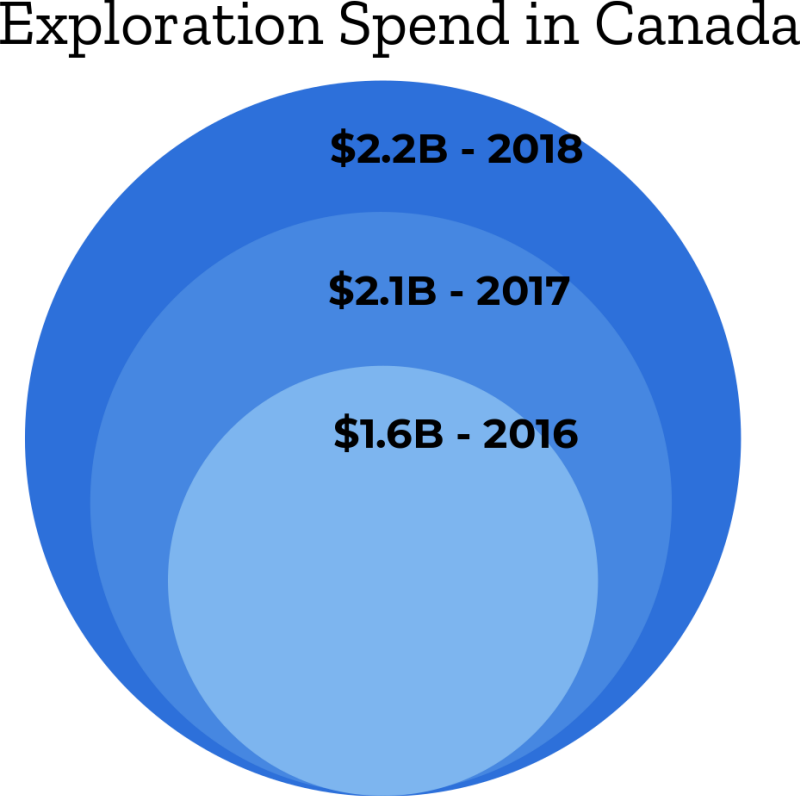
In Canada the exploration spend has grown 37% in the last two years, and total exploration spend in 2018 is forecast at $2.2B.


And consequently more core is heading to the lab.

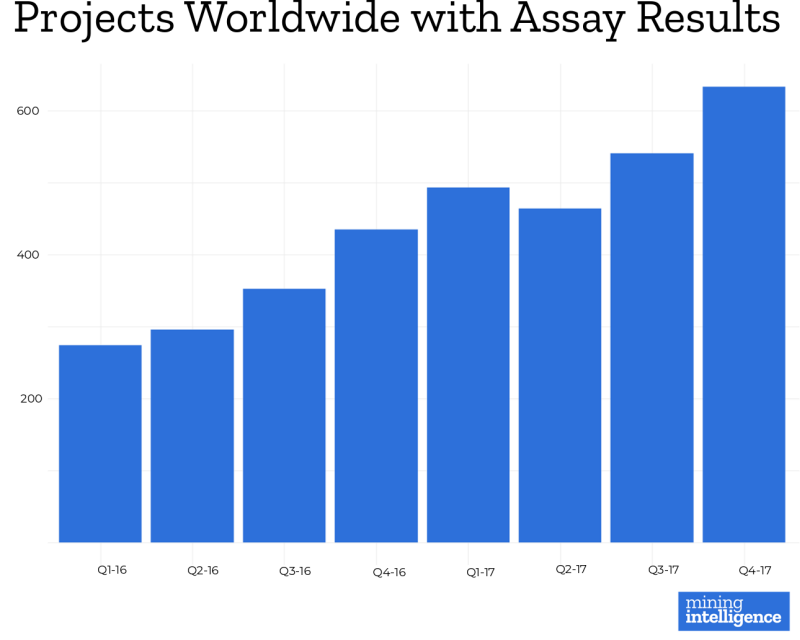
The number of projects worldwide with assay results increased 57% in 2017 over the previous year.


Sign up for Mining Intelligence and get rich insights about miners, juniors and projects. Our online tool puts rich data at your fingertips.

Creative commons image of diver by Ollie Harridge.

See the article online on mining.com here: http://www.mining.com/metal-prices-financings-exploration-assay-results/