Follow us on Twitter

Monday, May 17, 2021

Concerns mount that a supercharged global economy will stoke #inflation as Corporate buying & hoarding is pushing supply chains to the brink of seizing up.

In order "to survive the breakneck speed at which demand for goods is recovering and assuage that primal fear of running out. The corporate buying and hoarding is pushing supply chains to the brink of seizing up. Shortages, transportation bottlenecks and price spikes are nearing the highest levels in recent memory, raising concern that a supercharged global economy will stoke inflation."

See the article on Bloomberg: 

The World Economy Is Suddenly Running Low on Everything

by Brendan Murray, Enda Curran and Kim Chipman

'It is anything but efficient or normal.' Surging corporate demand is upending global supply chains. 

https://www.bloomberg.com/news/articles/2021-05-17/inflation-rate-2021-and-shortages-companies-panic-buying-as-supplies-run-short?


Friday, April 23, 2021

Coronavirus notwithstanding, Corporations purchased record 23.7GW of #CleanPower, +18%, in 2020 through long-term #PPA’s

  • Clean energy contracts were signed by more than 130 companies in sectors ranging from oil & gas to big tech.
  • Underpinning the market is surging stakeholder interest in corporate sustainability and expanding access to clean energy globally.
  • Corporate PPA volumes in the Europe, Middle East and Africa (EMEA) region nearly tripled, from 2.6GW in 2019 to a record 7.2GW in 2020. 
  • In Spain, companies announced contracts to purchase no less than 4.2GW of clean energy, up from 300MW the previous year. 
  • Solar and wind projects in Spain yield some of the cheapest and most competitive prices in Europe, thanks to strong natural resources and a large pool of experienced developers. 
  • Companies like Total and Anheuser Busch are orchestrating 'cross-border virtual PPAs' in Spain, buying clean energy in the country to offset their load elsewhere in Europe.
  • Amazon was the leading buyer of clean energy in 2020, announcing 35 separate clean energy PPAs in 2020, totalling 5.1GW. 
  • Amazon has now purchased over 7.5GW of clean energy to date, vaulting it ahead of Google (6.6GW) and Facebook (5.9GW) as the world's largest clean energy buyer. 
  • French oil major Total (3GW), TSMC (1.2GW) and U.S. telecom Verizon (1GW) were the next largest corporate buyers of clean energy in 2020 (see Figure 2).

Corporate Clean Energy Buying Grew 18% in 2020, Despite Mountain of Adversity | BloombergNEF

BloombergNEF
January 26, 2021


Corporations purchased a record 23.7GW of clean power through long-term agreements, propelled by growth in new markets

New York and London, January 26, 2021 – Corporations purchased a record of 23.7GW of clean energy in 2020, up from 20.1GW in 2019 and 13.6GW in 2018, according to new research published by BloombergNEF (BNEF). The increase came despite a year devastated by the Covid-19 pandemic, a global recession and uncertainty about U.S. energy policy ahead of the presidential election.

BNEF finds in its 1H 2021 Corporate Energy Market Outlook that clean energy contracts were signed by more than 130 companies in sectors ranging from oil & gas to big tech. Underpinning the market is surging stakeholder interest in corporate sustainability and expanding access to clean energy globally.

Kyle Harrison, BNEF senior associate and the lead author of the report, commented: "Corporations faced a wave of adversity in 2020 – internal corporate functions were disrupted on the outset of the pandemic, and many companies saw revenues plummet as global economies buckled. Question marks before – and after – the U.S. election further complicated long-term decision-making for companies. To not only maintain, but grow, the clean energy procurement market under these conditions is a testament to how high sustainability is on many corporations' agendas."

The U.S. was once again the largest market, but was less dominant than in previous years. Companies announced 11.9GW of corporate PPAs in the U.S. in 2020, down from 14.1GW in 2019 – the first year-on-year drop since 2016. The first half, coinciding with the start of the pandemic, was particularly subdued, with companies announcing just 4.3GW of corporate PPAs in the U.S. in that period.
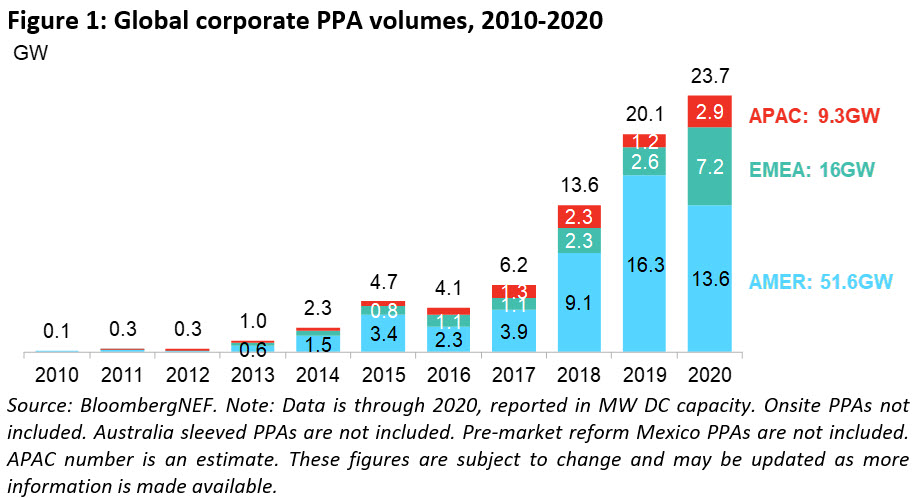
Latin America also had a down year, with PPA volumes dropping from 2GW in 2019 to 1.5GW in 2020. The region was hit hard by the Covid-19 pandemic and the economic downturn. Yet companies in Brazil signed a record 1,047MW of corporate PPAs in 2020, as many continued to migrate to the country's free market, where they can sign bilateral clean energy contracts directly with developers. Once the main draw for corporate procurement in the region, Mexico saw deal volumes all but dissipate, as the current administration continues to undermine the country's clean energy sector.

While the U.S. and Latin America slipped back, other corporate procurement markets stepped up. Corporate PPA volumes in the Europe, Middle East and Africa (EMEA) region nearly tripled, from 2.6GW in 2019 to a record 7.2GW in 2020. In Spain, companies announced contracts to purchase no less than 4.2GW of clean energy, up from 300MW the previous year. Solar and wind projects in Spain yield some of the cheapest and most competitive prices in Europe, thanks to strong natural resources and a large pool of experienced developers. Companies like Total and Anheuser Busch are orchestrating 'cross-border virtual PPAs' in Spain, buying clean energy in the country to offset their load elsewhere in Europe.

Corporations also purchased record clean energy volumes in the Asia Pacific (APAC) region, announcing contracts for 2.9GW of solar and wind. Taiwan established itself as a major corporate clean energy market in 2020, with companies signing PPAs totalling 1.25GW. Taiwan's market should be supported by a new policy that requires companies with an annual load above 5MW to buy clean power. Also, the island has a high concentration of large manufacturers, many of which are feeling pressure from their customers to decarbonize.

South Korea is expected to be the next major corporate procurement market in Asia. Policymakers revised the country's Electric Utility Act in the beginning of 2021, creating a PPA mechanism and a green tariff program with Korea Electric Power Corporation. The revision will also allow companies to purchase unbundled certificates and retire them against sustainability commitments. South Korean companies face similar supply chain pressures to those in Taiwan.

Jonas Rooze, lead sustainability analyst at BNEF, said: "More than ever before, corporations have access to affordable clean energy at a global scale. Companies no longer have an excuse for falling behind on setting and working towards a clean energy target."

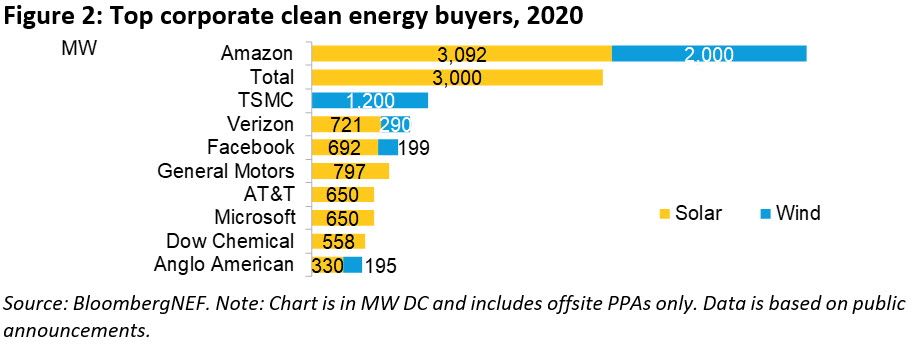
Amazon was the leading buyer of clean energy in 2020, announcing 35 separate clean energy PPAs in 2020, totalling 5.1GW. The company has now purchased over 7.5GW of clean energy to date, vaulting it ahead of Google (6.6GW) and Facebook (5.9GW) as the world's largest clean energy buyer. French oil major Total (3GW), TSMC (1.2GW) and U.S. telecom Verizon (1GW) were the next largest corporate buyers of clean energy in 2020 (see Figure 2).

The flow of new companies making clean energy commitments is another indicator of how much more the market can grow. Some 65 new companies joined the RE100 in 2020, pledging to offset 100% of their electricity consumption with clean energy. BNEF forecasts that the 285 RE100 members will collectively need to purchase an additional 269TWh of clean electricity in 2030 to meet their RE100 goals. Should this shortfall be met exclusively with offsite PPAs, it would catalyze an estimated 93GW of new, incremental solar and wind build.

Harrison commented: "Investor interest in sustainability is sky high, with inflows to sustainability-focused funds growing 300% between 2019 and 2020. Companies in all sectors, including hard-to-abate ones like oil & gas and mining, are feeling the pressure to purchase clean energy and decarbonize. This group is only just scratching the surface on the amount of clean energy build it can catalyze."
BNEF updates its data on corporate procurement each month and publishes a market outlook on corporate energy strategy bi-annually.

Contacts
Veronika Henze
BloombergNEF
+1-646-324-1596
vhenze@bloomberg.net

About BloombergNEF

BloombergNEF (BNEF) is a strategic research provider covering global commodity markets and the disruptive technologies driving the transition to a low-carbon economy. Our expert coverage assesses pathways for the power, transport, industry, buildings and agriculture sectors to adapt to the energy transition. We help commodity trading, corporate strategy, finance and policy professionals navigate change and generate opportunities.


See the article online here: https://about.bnef.com/blog/corporate-clean-energy-buying-grew-18-in-2020-despite-mountain-of-adversity/#:~:text=BNEF finds in its 1H,oil & gas to big tech.&text=Companies announced 11.9GW of,on-year drop since 2016. 

Thursday, March 4, 2021

“Everyone is getting in line, trying to get a piece of #CITGO and lock in a judgment from a US court.” #Venezuela #Bondholders Trying To Get Anything They Can...

Venezuela Bondholders Seek to Accelerate Payment on 2025 Notes - Bloomberg
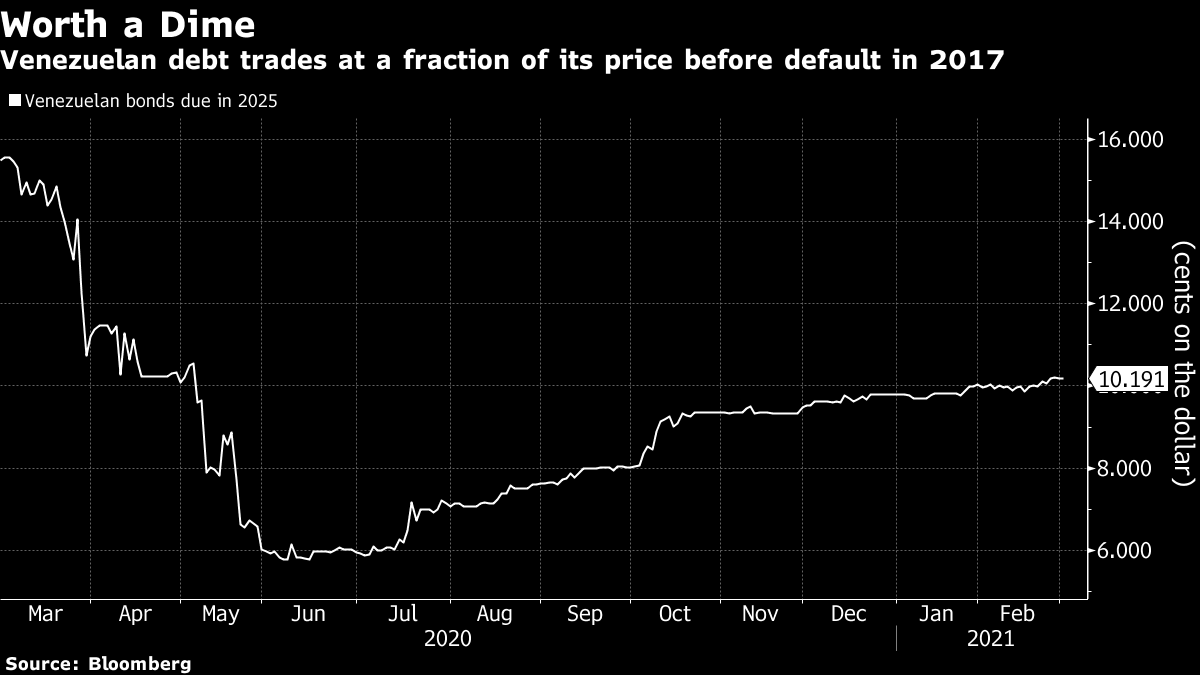
Venezuelan debt trades at a fraction of its price before default in 2017
Investors who hold at least 25% of Venezuela's benchmark dollar bonds due in 2025 are pushing to speed up payments on the notes after three years of sitting in default.

From Bloomberg:

The move may be largely symbolic as Venezuela's cash-strapped economy is in no condition to pay, and the South American nation's overseas assets are protected from seizure by U.S. sanctions. Still, the acceleration foretells a legal battle that's brewing over the country's $60 billion of defaulted debt as well as the state oil giant's Houston-based subsidiary Citgo.

"It's basically a frustration," said Russ Dallen, managing partner at Caracas Capital in Miami. Bondholders are looking at "the possibility of getting a court judgment and getting those Venezuelan assets as everyone is getting in line, trying to get a piece of Citgo and lock in a judgment from a U.S. court."

...

In September, a New York judge ruled that the country owes $390.7 million to Pharo Management and Casa Express Corp in overdue arrears, rejecting claims by the nation's representatives to delay the payment. The following month, London-based hedge fund Altana Wealth Ltd sued over defaulted debt. Bondholders have already accelerated on Venezuela's notes due in 2034.

Venezuela Bondholders Seek to Accelerate Payment on 2025 Notes

https://www.bloomberg.com/news/articles/2021-03-02/venezuela-bondholders-seek-to-accelerate-payment-on-2025-notes

Monday, February 22, 2021

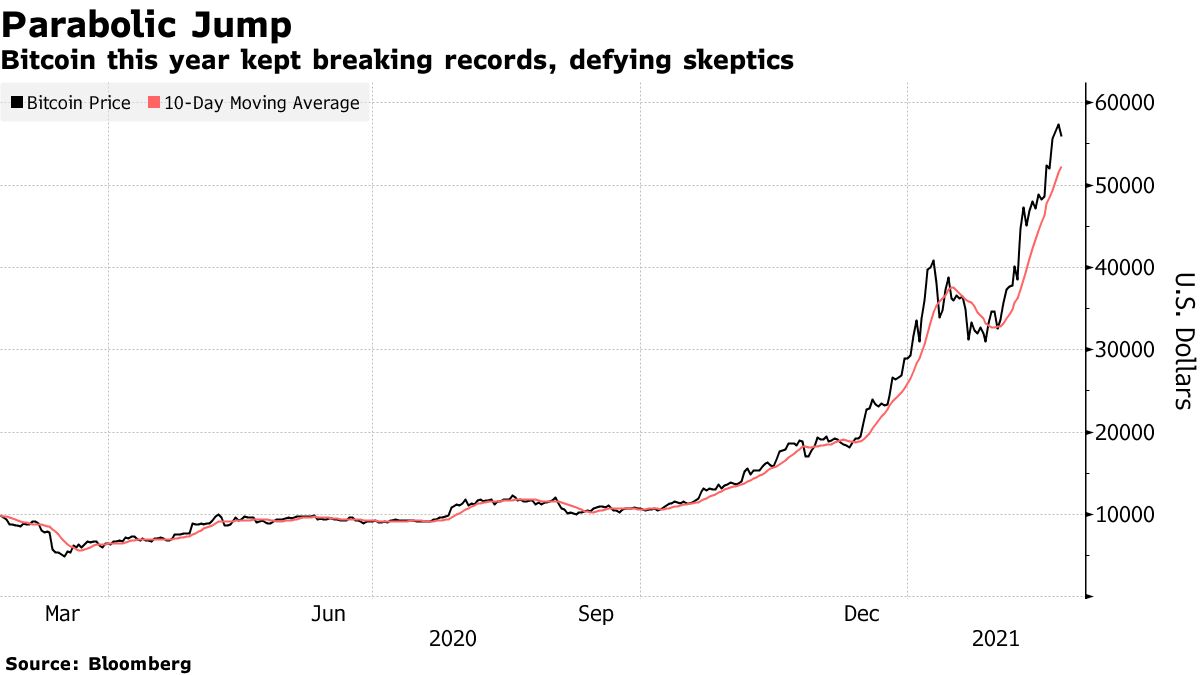
#Bitcoin’s roughly tripled in past 3 months, but its liquidity has deteriorated

Bitcoin Rally Faces Potential Test From Falling Market Liquidity - Bloomberg
#Bitcoin liquidity is only $10BN/day vs. $100BN for #Gold, making it much more prone to wild gyrations from relatively small orders. $BTCUSD

Bitcoin Rally Faces Potential Test From Falling Market Liquidity

Bitcoin rose as high as $58,350 on Sunday before retreating to about $56,200 as of 2:30 p.m. in Tokyo on Monday. The token has roughly tripled in the past three months but its liquidity has deteriorated, according to Nikolaos Panigirtzoglou, a strategist at JPMorgan Chase & Co.

"Market liquidity is currently much lower for Bitcoin than in gold or the S&P 500, which implies that even small flows can have a large price impact," he wrote in a note on Friday. 

Such a backdrop opens up the possibility of sharp moves higher or lower in the cryptocurrency depending on the prevailing ardor for digital assets. Of late, even some of the token's biggest backers appear surprised by its ascent. In a recent tweet, Elon Musk said Bitcoin prices "seem high," having earlier called it a "less dumb" version of cash.

Bitcoin trading volumes are around $10 billion daily for the spot and futures market combined, compared with an equivalent figure of $100 billion for gold, Panigirtzoglou wrote. That's consistent with "much lower liquidity in Bitcoin than in gold," he said.

Cryptocurrencies have enjoyed a strong start to the year, leaving other assets in the dust. The Bitcoin faithful argue corporate treasurers and institutional investors are new sources of demand and that the token can hedge risks such as faster inflation. Others see a prime example of speculative froth stoked by hedge funds and day traders in markets awash with stimulus.

"Bitcoin seems impervious to the barrage of fear, uncertainty and doubt waged against the industry," Paolo Ardoino, chief technology officer at cryptocurrency exchange Bitfinex, wrote in an email.

Shares of Asian cryptocurrency stocks advanced Monday in the wake of Bitcoin's all-time high. One of the biggest movers was Japan's Monex Group Inc., which jumped as much as 16%.

Ether, the largest token after Bitcoin, also rallied over the weekend, topping $2,000 for the first time on Saturday. It's up about 150% year-to-date.

See the piece on Bloomberg here: 

https://www.bloomberg.com/news/articles/2021-02-22/bitcoin-rally-faces-potential-test-from-falling-market-liquidity?sref=VxHCy32x

Wednesday, February 10, 2021

Someone is Missing Something... $TLRY $APHA

Aphria shareholders will get 0.8381 shares of Tilray for each common share of Aphria they hold.(1) 

The spread doesn't make sense w regards to the prices.!!